How long should a professional chair really last? The lifespan of an office chair varies significantly depending on its quality, usage, and maintenance. An entry-level seat can wear out in less than two years, while a high-end model maintains its performance for a decade. For companies and professionals who spend more than 1,700 hours per year seated at their workstation (source: OECD, 2025), recognizing wear signs becomes essential to preserve health, productivity, and furniture budget.
In this guide, you will discover the average lifespan of different types of chairs, the eight signs indicating it's time to change your office chair, as well as the factors that influence seat wear over the years.
What is the average lifespan of an office chair?
The lifespan of an office chair primarily depends on three elements: build quality, usage intensity, and maintenance rigor. Here are the ranges observed in the professional furniture industry.
By range and quality
- Entry-level chairs ($55 to $220 / 50 to 200 €): 1 to 3 years under intensive use
- Mid-range chairs (200 to 500 €): 3 to 7 years with regular maintenance
- Professional high-end chairs (500 € and above): 7 to 15 years or more
According to a BIFMA (Business and Institutional Furniture Manufacturers Association) study, a properly maintained professional ergonomic chair retains 85% of its initial performance after 10 years of daily use. Models certified BIFMA X5.1 are tested to withstand more than 100,000 sitting cycles, equivalent to approximately 10 years of intensive use.
By type of use
Usage intensity is a decisive factor in the longevity of an ergonomic chair. Moderate use (4 to 6 hours per day) naturally extends lifespan, while intensive use (8 hours or more, 3-shift positions) accelerates mechanical wear.
Good to know: At KWESK, our professional chairs are designed for intensive 24/7 use and benefit from a 5-year warranty on the structure, a durability guarantee that far exceeds market standards.
The 8 signs that indicate it's time to replace your office chair
Knowing when to change an office chair relies on the precise identification of wear signs. Here are the most reliable indicators that ergonomics professionals recommend monitoring.
1. The seat sags and loses its bounce
This is the most common wear sign. When high-density foam compresses permanently, your weight is no longer properly distributed. You feel the rigid base of the seat after a few hours, and pressure on the ischial bones increases significantly.
According to INRS (French National Research and Safety Institute), a sagging seat multiplies the long-term risk of lumbar musculoskeletal disorders (MSDs) by 2.3.
2. The gas lift no longer holds the height
If your chair gradually descends while you work, the gas lift is defective. This component has an average lifespan of 5 to 8 years under daily use. Fortunately, it is often replaceable: check our guide to change the gas cylinder of your chair before considering a complete replacement.
3. The casters are jammed, cracked, or broken
Defective casters force you to push the chair instead of rolling it, which abnormally stresses the shoulders and back. If only the casters are at fault, it is generally more economical to replace the chair casters than to change the entire seat.
4. The tilt mechanisms no longer work
A jammed synchronous or rocking mechanism prevents the micro-movements essential for maintaining good blood circulation. If the adjustment levers are broken or the tilt no longer locks, the ergonomic function is compromised.
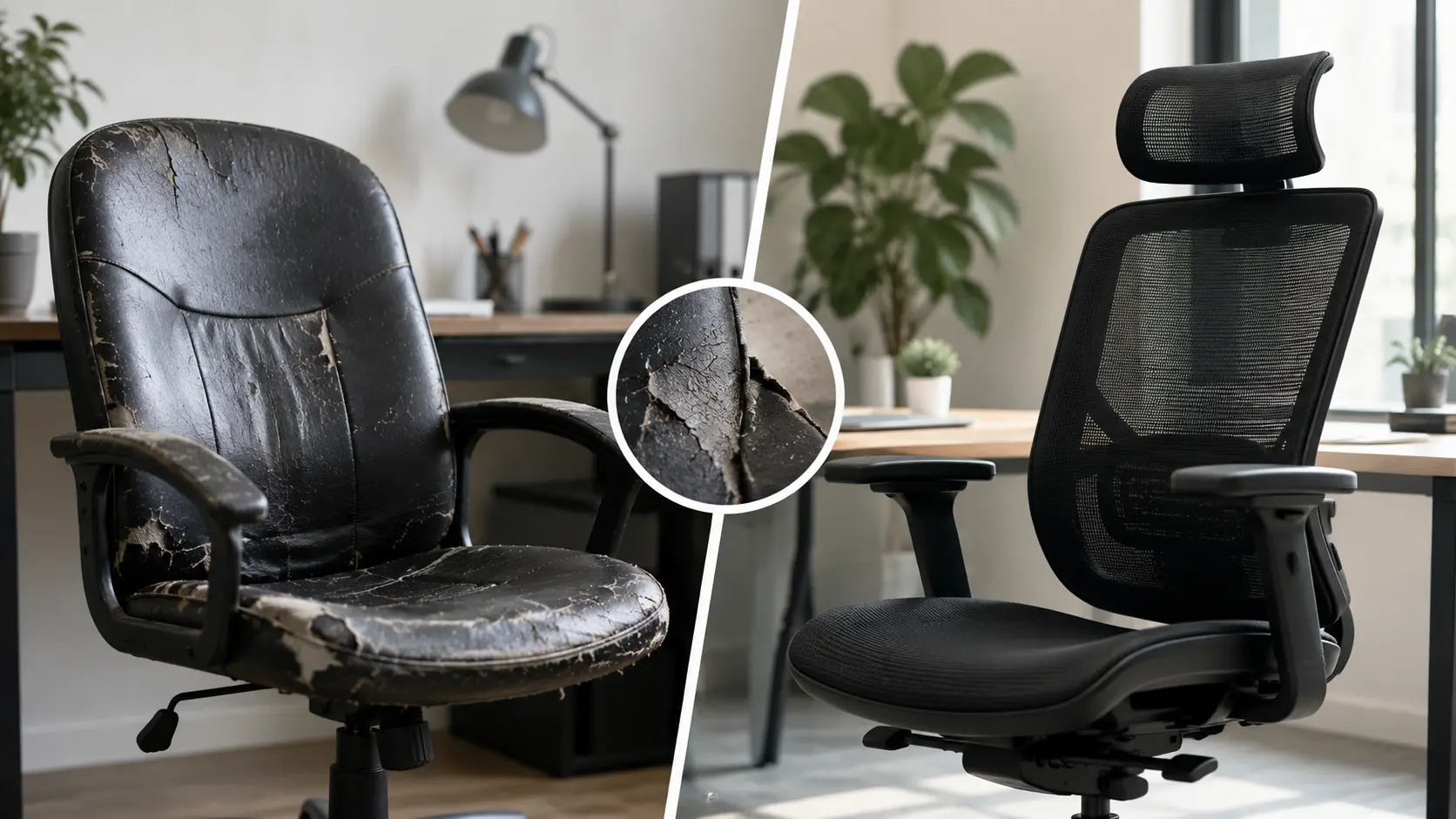
5. The upholstery is torn, stained, or worn
Beyond the aesthetic aspect (important in client-facing or executive environments), damaged upholstery may reveal degradation of the underlying foam. For healthy but dirty fabric, check our tips to clean your chair by material type.
6. The base shows cracks or rust
The base (5-star wheelbase) supports the entire user's weight. A crack, even minor, on plastic or an advanced rust point on metal represents a major safety risk. Do not delay in replacing a damaged base.
7. Persistent squeaks and noises
Squeaks can often be resolved by targeted maintenance (see our guide to repair a squeaking or sagging office chair). However, if the noises persist despite maintenance and concern the internal mechanisms, this indicates deep structural wear.
8. You feel persistent pain
This is probably the most important sign. If you develop lumbar pain, cervical pain, or numbness when the chair did not pose a problem before, its ergonomic support has deteriorated. A Cornell University study (2024) demonstrates that a failing ergonomic seat increases MSD-related sick leave by 32%.
Factors that influence the longevity of an ergonomic chair
Several parameters determine how quickly seat wear manifests. Understanding these factors helps you anticipate and invest wisely.
Material quality
Critical components make the difference in longevity:
- Cold-molded foam (high density 50-55 kg/m³): resists deformation 3 to 5 times better than standard foam
- Steel mechanisms: superior durability compared to plastic or light alloy mechanisms
- BIFMA class 4 gas lift: designed for intensive use
- Technical upholstery (full-grain leather, high-density breathable mesh): maintain their appearance longer
User weight and morphology
Most standard chairs are tested for a maximum weight of 110 to 120 kg. Regularly exceeding this limit significantly accelerates wear on the mechanisms and seat. For users with larger builds, opt for reinforced models such as the KWESK Corpo range, specifically designed to support up to 150 kg.
The work environment
Humidity, direct sunlight exposure, and air quality influence material degradation. An air-conditioned and temperate environment (18 to 22 °C, 40 to 60% humidity) extends lifespan by about 20%.
Maintenance regularity
Preventive maintenance every 6 months (checking screws, lubricating mechanisms, cleaning upholstery) can double the lifespan of a professional chair.
Repair or replace: how to decide?
This question is crucial, especially for procurement managers and office managers handling furniture fleets. Here is a decision grid based on field experience.
Prioritize repair when:
- The chair is less than 5 years old and the main structure is sound
- Only 1 or 2 components are defective (casters, gas lift, armrests)
- The cost of repair is less than 30% of the price of an equivalent new chair
- The model is high-end and spare parts are available
Opt for replacement when:
- The age of the chair exceeds its nominal lifespan (consult manufacturer specifications)
- Several components are simultaneously failing
- The base or main mechanism is damaged
- The chair causes pain despite adjustments
- Spare parts are no longer available
For an in-depth analysis, consult our complete guide on office chair replacement.
Quick ROI calculation: A professional chair at 600 € lasting 10 years costs 60 € per year. A 200 € model lasting 2 years costs 100 € per year, not counting hidden costs (management time, health impact). Investment in durability is almost always profitable.
How to extend the lifespan of your office chair
A few good practices help optimize the longevity of an ergonomic chair and delay its replacement.
Essential maintenance routine
- Weekly cleaning: vacuuming dust and wiping surfaces
- Monthly check: tightening visible screws and testing all adjustments
- Semi-annual lubrication: applying suitable lubricant to moving points
- Annual inspection: thorough check of gas lift, mechanism, and base
Daily good habits
- Do not sit on the armrests, they are not designed to support your weight
- Avoid tilting backward on two casters
- Properly adjust the height to avoid forcing the gas lift
- Protect the floor with a suitable mat if you work on dense carpet
Choose durable products from the start
The initial investment in a quality chair is the best guarantee of longevity. Prioritize manufacturers offering a long warranty (5 years minimum) and spare parts available in the long term. Discover the professional ergonomic chair buying guide to identify essential criteria.
The impact of a worn chair on health and productivity
Keeping a failing seat for budgetary reasons is rarely profitable in the medium term. The consequences of a degraded ergonomic chair are documented.
According to the European Agency for Safety and Health at Work (EU-OSHA, 2025), MSDs represent 60% of all recognized occupational diseases in Europe, with an average cost of 1,200 € per employee per year for the company. A failing ergonomic chair is a direct risk factor, as detailed in our article on ergonomic chairs and the prevention of MSDs and back pain.
On the productivity side, discomfort leads to a concentration drop estimated between 12 and 18% according to cognitive ergonomics studies. Investing in a high-performance seat therefore directly improves team performance.
Conclusion: anticipate replacement to optimize health and budget
The lifespan of an office chair is an essential indicator to integrate into any professional space strategy. By monitoring the eight wear signs detailed and practicing regular maintenance, you maximize the longevity of your furniture while preserving the health of your teams.
Remember the key points:
- A quality professional chair lasts between 7 and 15 years with proper maintenance
- The most critical wear signs concern the seat, gas lift, base, and mechanisms
- Repair is often possible and economical for high-end models
- The initial investment in a durable seat is almost always profitable
Are you considering renewing your seating fleet? Discover our best office chairs 2026 or explore our professional ranges designed to last: Gamma, Challenger, and Exclusive. For a personalized audit of your furniture fleet or a quote request, contact the KWESK team. Our experts support you in choosing durable, ergonomic furniture adapted to your usage intensity.