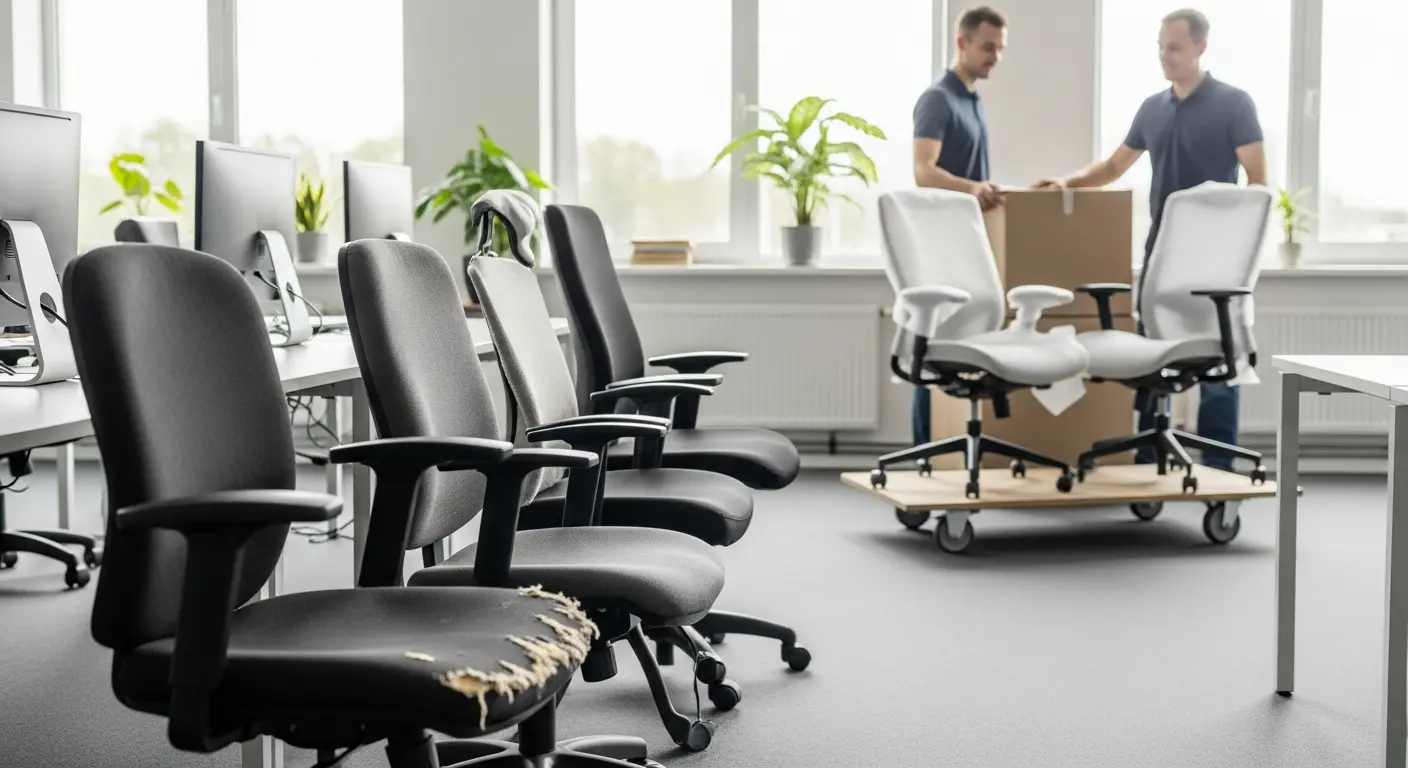
The gas cylinder that sinks on its own, the backrest that creaks with every movement, the seat that no longer provides any support... Do these symptoms sound familiar? They indicate it's time to consider replacing the chairs in your company. With 87% of occupational diseases in France linked to musculoskeletal disorders (MSDs), faulty furniture isn't just a matter of comfort—it's a public health issue. This guide details the warning signs to watch for and the methods to efficiently organize the renewal of your professional seating.
The Urgency of Replacing Worn Office Chairs
A Major Health Issue
MSDs are the leading cause of occupational disease in France. According to INRS, these disorders resulted in the loss of more than 23 million working days in 2019. The back and upper limbs are particularly affected: nearly 60% of women and more than 50% of men report MSD-related pain.
A worn chair significantly aggravates these risks. When the lumbar support collapses or the seat no longer maintains proper posture, mechanical stress on the spine increases. An adapted ergonomic chair prevents these problems by maintaining the body's natural alignment.
The Real Cost of Inaction
Postponing chair replacement costs companies dearly. The figures speak for themselves:
- 2 billion euros: annual direct cost of MSDs for French companies (occupational accident/disease contributions)
- 11 million days of work lost in 2021 for limb-related MSDs alone
- 25% of sick leave is due to musculoskeletal disorders according to Malakoff Humanis
Indirect costs—decreased productivity, turnover, employer brand deterioration—multiply these amounts by 10 to 30 according to studies. Faced with these figures, investing in furniture renovation becomes an economic necessity.
The 7 Signs Indicating a Necessary Chair Replacement
1. The Gas Cylinder No Longer Holds
The pneumatic gas cylinder maintains the seat at the desired height. When it weakens, the chair gradually sinks throughout the day. Do you find yourself raising the seat several times a day? The internal seal is worn. Although replaceable, a failing gas cylinder often signals advanced general wear.
2. Squeaking and Creaking
Metallic or plastic noises with every movement indicate that internal components are approaching the end of their life. These sounds generally come from bearings, pivot points, or the tilt mechanism. Beyond the noise nuisance, they herald imminent mechanical failures.
3. Sagging Seat
Seat foam compresses over time. When it no longer returns to its shape after use, comfort and support disappear. A flat or hollow seat transfers body weight unevenly, generating painful pressure points and back problems.
4. Deteriorated Upholstery
- Torn fabric: exposes the foam to accelerated degradation
- Cracked leather: a well-maintained leather chair lasts a long time, but cracking indicates end of life
- Stretched mesh: loses its support and ventilation properties
5. Unstable Armrests
Armrests that move, pivot unintentionally, or no longer maintain their position compromise forearm support. This instability forces the shoulders and neck to compensate, creating chronic muscle tension.
6. Failing Backrest
A backrest that no longer stays in position, tilts unpredictably, or no longer reclines correctly no longer fulfills its ergonomic function. Back support becomes unreliable, promoting poor posture.
7. Compromised Structure
Cracked base, tilting leg, broken casters: these signs require immediate chair replacement. A structurally failing seat presents a serious accident risk that no company can ignore.
Practical rule: If 3 or more signs appear simultaneously, replacement becomes more economical than repair.
Lifespan: When to Anticipate Seat Renewal?
Life Expectancy by Range
Longevity varies considerably depending on initial quality:
| Category | Lifespan | Characteristics |
|---|---|---|
| Entry-level | 1 to 3 years | Basic components, light use |
| Mid-range | 5 to 7 years | Standard mechanisms, regular use |
| High-end ergonomic | 10 to 15 years | Premium components, intensive use |
| Executive leather chair | 10+ years | Premium materials, maintenance required |
A specialized manufacturer offering a 5-year warranty demonstrates the robustness of their products. This warranty is a reliable indicator of actual lifespan.
The Renewal Rule
Generally, plan for seat renewal at the warranty duration + 2 to 3 years. Beyond that, a thorough inspection is required, particularly for:
- Seat foam condition
- Gas cylinder condition
- Adjustment mechanism stability
Factors Accelerating Wear
Certain conditions significantly reduce lifespan:
- Intensive use: more than 8 hours daily
- High load: regular exceeding of recommended capacity
- Environment: dust, humidity, temperature variations
- Lack of maintenance: no cleaning or preventive maintenance
How to Organize Chair Replacement?
Phase 1: Audit of Existing Stock
Before any purchase, assess the current state:
- Complete inventory: list all seats by department and location
- Individual assessment: classify each chair (good condition / moderate wear / to be replaced)
- History: note the age and origin of each seat if possible
- User survey: collect feedback on perceived comfort
This mapping reveals priorities and determines the necessary budget.
Phase 2: Defining Needs
Not all workstations require the same type of seat. Identify specific needs:
Operational workstations (open space, call center):
- Intensive use, possible user rotation
- Priority on robustness and ease of adjustment
- Essential ergonomic criteria to be respected
Executive positions:
- Extended use, representation
- Executive chair with premium finishes
- Premium materials (leather, wood)
Specific positions:
- Reception: aesthetics and visitor comfort
- Meeting rooms: stackable or on casters
- Sit-stand positions: chairs without casters or ergonomic stools
Phase 3: Model Selection
To choose the best chair, evaluate:
Mandatory ergonomic criteria:
- Height and depth adjustable lumbar support
- Adjustable seat height (range adapted to your workforce)
- Adjustable seat depth
- 3D or 4D armrests
- Synchronized backrest tilt
Durability criteria:
- Certification for intensive use (24/7 if necessary)
- Minimum 5-year manufacturer warranty
- Spare parts availability
- Manufacturer reputation
Practical criteria:
- Ease of upholstery cleaning
- Compatibility with your desks (height, access)
- Weight and maneuverability
Phase 4: Deployment Planning
Avoid massive replacement all at once. Adopt a progressive approach:
Priority 1 (immediate): Chairs presenting safety risks Priority 2 (3-6 months): Very worn seats generating complaints Priority 3 (6-18 months): Aging but functional furniture Priority 4 (18-36 months): Preventive replacement of remaining stock
This strategy smooths out the investment and allows adjustments based on field feedback.
Best Practices for Successful Furniture Renovation
Involve Users
Chair replacement directly concerns employees. Their participation promotes buy-in:
- Preliminary tests: install 2-3 models for trial over 2 weeks
- Structured feedback: questionnaire on comfort, adjustments, aesthetics
- Deployment training: explain adjustments for optimal use
A perfectly ergonomic chair that's poorly adjusted loses all its benefits.
Choose the Right Partner
A reliable supplier guarantees quality and follow-up:
- Industry expertise: prioritize professional furniture specialists
- Personalized advice: analysis of your needs, tailored recommendations
- After-sales service: maintenance, spare parts, warranty extensions
- Verifiable references: request similar client cases
Managing Old Furniture
Chair replacement generates volume to be handled responsibly:
- Donation: associations, schools, integration organizations for still-functional furniture
- Manufacturer take-back: some suppliers collect the old stock
- Recycling: specialized channels (metal, plastic, foam)
- Refurbishment: companies specializing in restoration
Avoid landfill disposal, incompatible with CSR commitments.
Calculating Return on Investment
Total Cost of Ownership
Don't compare purchase prices only. Include:
| Item | 300 Euro Chair (3 years) | 700 Euro Chair (10 years) |
|---|---|---|
| Purchase | 300 Euro | 700 Euro |
| Replacement (10 years) | 900 Euro (3 purchases) | 700 Euro |
| Maintenance | ~100 Euro | ~150 Euro |
| Total over 10 years | ~1000 Euro | ~850 Euro |
The premium chair costs less in the long run while offering better comfort.
Measurable Gains
After furniture renovation, track:
- Evolution of MSD-related absenteeism
- Employee satisfaction (before/after survey)
- Discomfort-related complaints
- Productivity of affected teams
Studies indicate a 17 to 25% productivity increase thanks to adapted ergonomic chairs, and an absenteeism reduction that can reach 75%.
Conclusion
Office chair replacement goes beyond a simple furniture question: it's an investment in the health, well-being, and performance of your teams. By monitoring signs of wear, methodically planning seat renewal, and selecting models adapted to each workstation, you create the conditions for efficient and serene work.
Don't wait for pain to set in or accidents to occur. Every day spent on a failing chair worsens MSD risks and their associated costs.
Discover our range of professional ergonomic chairs designed for intensive use and guaranteed for 5 years, or contact our experts for personalized support with your renewal project.