A clean chair is a chair that lasts. Yet most professionals don't know how to clean an office chair without damaging its upholstery, and end up with ingrained stains, cracked leather or grey-tinged mesh within just two years. The method changes radically depending on the material: what saves a fabric can destroy a leather, and what works on leather can clog a mesh.
This complete guide gives you, material by material, the products to use, the gestures to adopt and the mistakes to avoid to keep your seat spotless for years.
Why office chair maintenance is strategic
An employee spends an average of 1,700 hours per year sitting at their workstation. The result: dust, crumbs, sweat, cosmetics and micro-drops of coffee accumulate in the fibres and foams. According to a study by Initial Hygiene, a poorly maintained office chair can harbour up to 21,000 germs per square centimetre — more than a toilet seat.
Beyond the sanitary aspect, maintenance plays a direct economic role. A premium ergonomic chair represents an investment of several hundred euros. Regular cleaning can double its lifespan and postpone by several years the replacement of office chairs for an entire team.
Good news: none of these methods require professional equipment. A microfibre cloth, two or three basic products and ten minutes a month are enough.
Before you start: the 4 universal rules
Whatever the material of your seat, these rules apply.
- Test on a hidden area first. Under the seat or at the back of the backrest, apply your product on a small area and wait 10 minutes to check it doesn't discolour.
- Never soak the fabric or foam with water. Stagnant moisture encourages mould and water marks.
- Always blot, never rub. Rubbing spreads the stain and damages the fibres.
- Vacuum before washing. Removing dust and particles prevents them from being driven in during cleaning.
Also get into the habit of checking the care label under the seat. The codes W, S, WS or X indicate, respectively: water cleaning, solvent cleaning, both, or vacuum only.
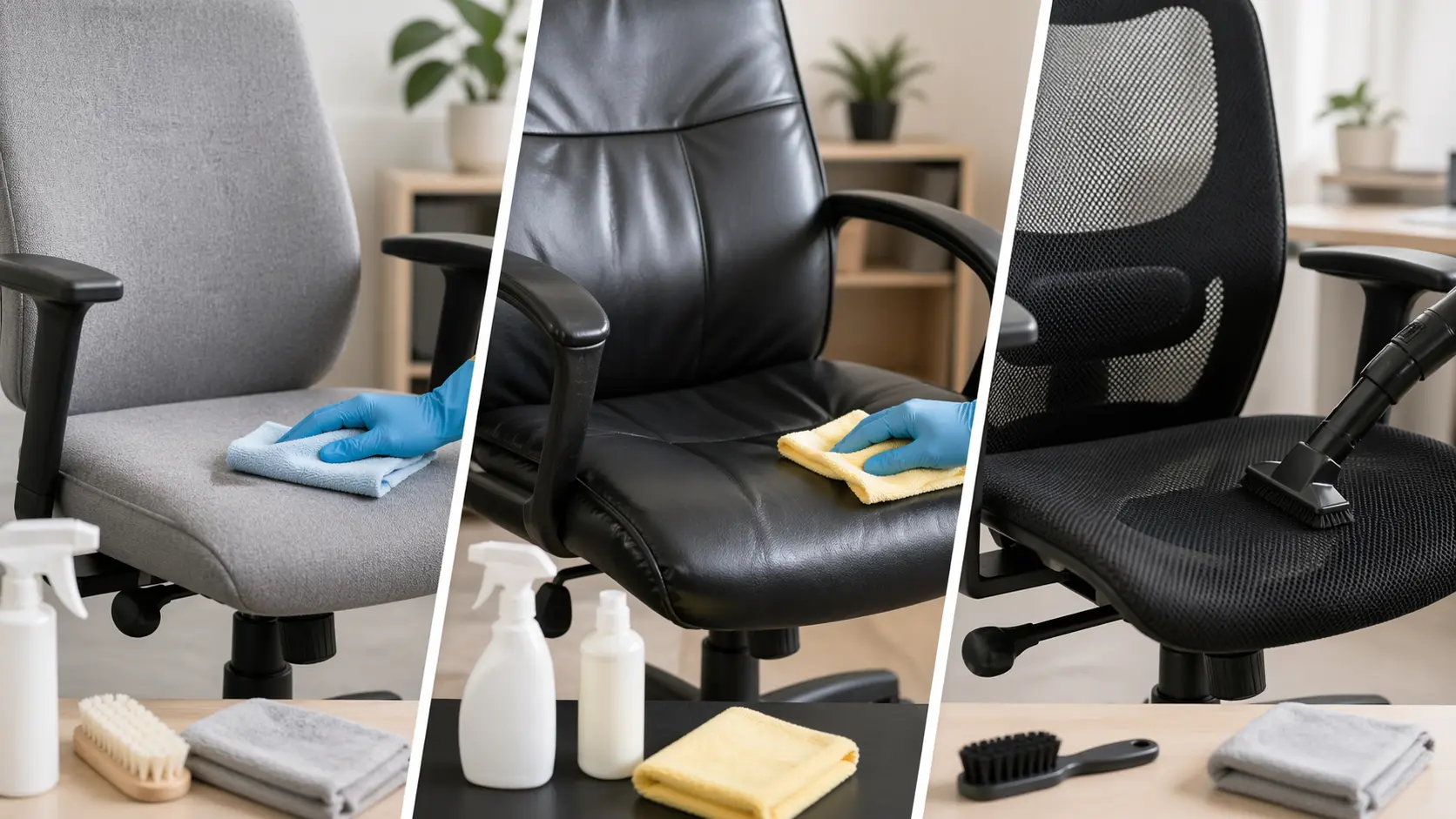
How to clean a fabric office chair
Fabric is the most common upholstery in companies. It is warm and breathable, but easily absorbs liquids and retains odours.
Weekly fabric maintenance
Vacuum with the soft brush attachment over the entire surface, focusing on the seams and the gap between the seat and the backrest. Done once a week, this step removes 80% of the dirt before it sets in.
Monthly deep cleaning
To clean a fabric office chair more thoroughly, prepare the following solution:
- 500 ml of warm water
- 1 tablespoon of mild washing-up liquid
- 1 tablespoon of white vinegar
Dip a microfibre cloth, wring it out firmly until it is barely damp, and blot the entire surface using circular motions. Rinse with a second cloth soaked in clean water, then let it air-dry away from direct sunlight and radiators.
Removing stains from a fabric office chair
To remove stains from an office chair, the right product depends on the stain:
- Coffee, tea, soda: water + white vinegar mix (50/50), blot from the outside in.
- Ink, pen: household alcohol on a cotton bud, in small dabs.
- Grease, make-up: sprinkle with baking soda, leave for 30 minutes, vacuum, then blot with soapy water.
- Blood: cold water only — never hot water, which would set the proteins.
Pro tip: for persistent odours (sweat, perfume, tobacco), sprinkle the seat with baking soda in the evening, leave it overnight and vacuum the next morning. This neutralises 90% of odours without damaging the fabric.
For intensive open-space seats, choose models designed for heavy daily use such as KWESK professional office chairs, whose upholstery is tested to withstand more than 100,000 sitting cycles.
How to maintain a leather office chair
Leather is the hallmark of a director's office, but it is also a living material that needs to stay hydrated. Without leather care, it dries out, cracks and loses its colour in less than three years.
Weekly leather cleaning
Dust with a soft, dry microfibre cloth. If the dust is ingrained, slightly dampen the cloth with clean water (definitely no standard household cleaner) and immediately wipe with a second dry cloth.
Monthly cleaning and nourishing
Use a leather-specific cleaning milk (glycerine soap or Marseille soap diluted to 5%). Apply small amounts onto a cloth, go over the entire surface in circular motions, rinse with a well-wrung damp cloth, then dry.
Every 2 to 3 months, nourish the leather with a hydrating milk or a specific cream. This step is crucial: well-nourished leather stays supple, keeps its colour and better resists daily friction.
What you must never do to leather
- No alcohol, acetone or standard household products: they strip the protective layer.
- No large amounts of water: it penetrates the leather and leaves water marks.
- No direct sun or heat exposure: it dries out the material irreversibly.
If you are still hesitating between different upholstery options for your executives, our leather office chair guide details the advantages and specific care requirements by type of leather (full grain, semi-aniline, corrected leather).
Removing stains from a leather chair
- Ink: apply a little alcohol-free cleansing milk, leave for 5 minutes, wipe off.
- Grease: sprinkle with talc or Sommières earth, let it absorb for 24 hours, brush gently.
- Dark marks: baby milk on a soft cotton pad, then nourish with a leather cream.
How to clean a mesh office chair
Mesh — that technical netting stretched over a frame — has become the benchmark for modern ergonomic chairs. It offers excellent breathability, but its mesh structure traps dust and lint. Poor mesh cleaning can loosen the fabric or distort the fibres.
Routine mesh maintenance
Once a week, vacuum with a soft brush attachment, directly on the backrest and seat. For tricky areas, a soft-bristled brush or a dry toothbrush helps dislodge particles caught in the mesh.
Deep cleaning
Prepare some warm water with a few drops of mild washing-up liquid. Soak a microfibre cloth, wring it out as much as possible, and blot the mesh without pressing hard. Rinse with a clean damp cloth, then let it dry naturally. Never use a hair dryer or radiator: heat softens and loosens synthetic fibres.
For localised stains, a water + white vinegar solution (80/20) applied with a soft brush is very effective. Vinegar disinfects and neutralises odours without leaving residue.
Mistakes to avoid on mesh
- Never use an abrasive sponge or hard brush: they break the fibres.
- Do not spray product directly onto the mesh: the drops go through and wet the seat foam underneath.
- Do not use bleach, even diluted: it irreversibly yellows the mesh.
If your team is looking for a mesh chair designed for intensive use, explore the Challenger range, whose high-density mesh is tested to hold its tension throughout the 5-year warranty.
Don't forget the other components of the chair
The upholstery is only part of the seat. For complete maintenance:
- Plastic or polyurethane armrests: damp cloth + a few drops of washing-up liquid.
- Aluminium or chrome base: dry microfibre, then metal polish every 6 months.
- Castors: remove hair and fibres wound around the axle using pliers or a cutter (chair upside down). Clean castors preserve the floor and roll silently.
- Gas lift and mechanism: visual inspection every 6 months to spot leaks or abnormal play.
A chair that squeaks or sags isn't always dead: often, a simple castor cleaning and screw tightening gives it several more years of comfort. If the chair truly reaches end-of-life, check our ergonomic chair comparison to choose a suitable replacement.
Recommended maintenance schedule
For a chair used 8 hours a day in a standard office environment:
- Each week: vacuuming + dusting.
- Each month: complete wet cleaning of the upholstery.
- Every 3 months: nourish leather if applicable, clean castors, inspect screws and mechanisms.
- Once a year: professional deep cleaning (injection-extraction for fabrics, specific shampoo for leather).
A well-maintained workstation directly supports employee health: a clean, comfortable seat limits muscle tension and supports effective prevention of MSDs and back pain.
Should you hire a professional?
For a fleet of more than 20 chairs, annual professional cleaning is often more cost-effective than in-house cleaning: budget between €15 and €40 per seat depending on the material. Specialised companies use injection-extraction machines that reach deep into foams without over-wetting.
On the other hand, for fewer than 10 workstations, monthly in-house maintenance is more than enough — provided the methods described above are applied.
Conclusion: longevity is decided day by day
Cleaning an office chair requires neither expensive products nor specific expertise: you just need to know its material and be consistent. A properly vacuumed fabric, a regularly nourished leather and a carefully blotted mesh can last 8 to 10 years without losing comfort or appearance.
At KWESK, we design our chairs for intensive use with easy-care upholstery and a 5-year warranty. Discover our range of professional ergonomic seats or contact our advisors for a quote tailored to the size of your company. And if your current seats are reaching end-of-life, our replacement guide will help you plan the renewal without disrupting your teams.