Every year, thousands of office chairs end up in the bin due to faulty casters — when a $15 replacement kit and ten minutes are all it takes to fix the problem. Yet replacing the casters on your office chair is not as straightforward as it seems: buying the wrong stem diameter, confusing carpet casters with hard floor casters, or choosing a model incompatible with your hardwood floor are very common mistakes. This guide does not simply explain how to remove and refit casters — it first helps you avoid the poor purchasing decisions that make the whole operation pointless or, worse, that keep damaging your floor.
The 3 Mistakes to Avoid Before You Even Buy
Mistake #1: Ordering Without Measuring the Stem
This is the most frequent error. Universal casters sold in most markets come in two stem diameters: 10 mm and 11 mm. The difference is one millimetre — invisible to the naked eye, but critical at installation. An 11 mm stem in a housing designed for 10 mm will not fit. A 10 mm stem in an 11 mm housing will hold poorly and eventually come loose under the weight.
Before any purchase, remove one caster from your chair and measure the stem diameter with a calliper. Also note the insertion length (generally 22 to 25 mm). These two measurements are enough to avoid a failed purchase.
Mistake #2: Buying the Same Original Casters Again
The majority of office chairs are fitted with carpet casters — even when they are used on hardwood or tiled floors. On a hard floor, these nylon casters are subjected to too much pressure, do not glide correctly, and deteriorate quickly. The result: the new casters ordered as replacements wear out just as fast as the previous ones.
The rule to remember once and for all: soft caster for hard floor, hard caster for soft floor.
Mistake #3: Replacing Only the One Broken Caster
A new caster combined with four worn ones creates a minimal but real height imbalance, which strains the knees, imperceptibly alters posture, and accelerates wear on the new part. A set of 5 casters costs barely more than a single caster sold individually. It is always the better calculation. When replacing, it is recommended to change all casters at the same time to ensure even rolling and avoid imbalances caused by uneven wear.
Identifying Your Fitting Type: The 3 Systems
Confusing fitting systems leads to an unusable purchase. Here is how to tell them apart before ordering.
Press-Fit Stem (the standard on 95% of chairs)
The caster has a smooth cylindrical stem that is pressed into a socket on the star base. No screws, no threading: pressure alone holds the caster in place. This system is compatible with the vast majority of chairs on the market — entry-level, mid-range, most Scandinavian brands, and standard office chairs.
To confirm: turn your chair upside down. If the caster appears to simply be "plugged into" the base with no visible screws or nuts, this is the system you have.
Threaded Stem (screwed)
Found on certain professional models or older executive chairs. Turn the caster counter-clockwise: if you feel progressive resistance and it eventually unscrews, it has a threaded stem. Note: a heavily worn caster may also spin freely without being threaded — do not rely on this observation alone if the stem is rusted.
Plate Fixing
A metal plate screwed to the underside of the base, with 2 to 4 fixing screws. Reserved for very heavy-duty chairs or heavy executive seats. It offers superior resistance but requires a screwdriver and sometimes a nut for removal. There are 3 types of office chair caster fixing: stem fixing, eye fixing, or plate fixing — only a visual inspection of the underside of your star base will allow you to identify yours with certainty.
Choosing Casters for Your Floor Type: The Right Diagnosis
No caster is truly universal in the sense of "suitable for all floors." Floor compatibility is the most important criterion — and the most frequently overlooked.
Solid hardwood, engineered wood, laminate: choose polyurethane (PU) or TPR casters, with a minimum wheel diameter of 50 mm. The PU band absorbs micro-vibrations, rolls silently, and leaves no marks. Avoid hard nylon, which will irreparably scratch these surfaces within weeks.
Tiles or polished concrete: PU works perfectly. Nylon casters can be suitable on well-grouted hard tiles, but they produce more noise and may erode the grout over time. On polished concrete, PU is essential to preserve the polished appearance.
Carpet and rugs: hard nylon casters are the best choice here. Their rigid tread rolls over the fibres without sinking in or tearing them. PU casters sink into carpet and create resistance that tires the legs from the first hour of work.
Open-plan or shared workspace: silent PU casters are the professional standard. They absorb vibrations on hard floors and maintain a low noise level — a criterion often underestimated in shared spaces where every chair movement is audible.
Laboratory, server room, or environment sensitive to electrostatic discharge: anti-static casters exist specifically for these uses. In laboratories, hospitals, or server rooms, anti-static casters are essential to prevent electrostatic discharges. This type of caster is never mentioned in general consumer guides, but represents a genuine safety requirement in these environments.
To understand how these choices fit into a well-thought-out overall workstation setup, our article on workstation ergonomics provides the key criteria.
Step-by-Step Installation (No Tools Needed in 95% of Cases)
Once the right casters have been ordered and received, installation takes less than 10 minutes.
What you might need: WD-40 if the casters are seized, a small flathead screwdriver as a last resort, a cloth, and that is all.
Lay the chair on its side on a stable surface. Make sure the star base is accessible without constraint. Some people prefer to turn it completely upside down — both positions work depending on your comfort.
Remove the old casters. Hold the base with one hand and pull the caster with the other. In rare cases, you may need to lever upwards at the socket using a narrow pair of pliers. If a caster resists after years of compression, apply a few drops of WD-40 to the joint, wait 2 minutes, and try again.
Clean the sockets. The retaining rings from the old casters must not remain stuck in their housing, as they would prevent the new parts from fitting. Use a cotton swab or thin cloth to remove dust and residue.
Check the quality of the new casters before installing them. Spin each caster by hand: it should turn freely and silently. A poor-quality caster squeaks even when spun without load — this is a reliable indicator of a very short lifespan.
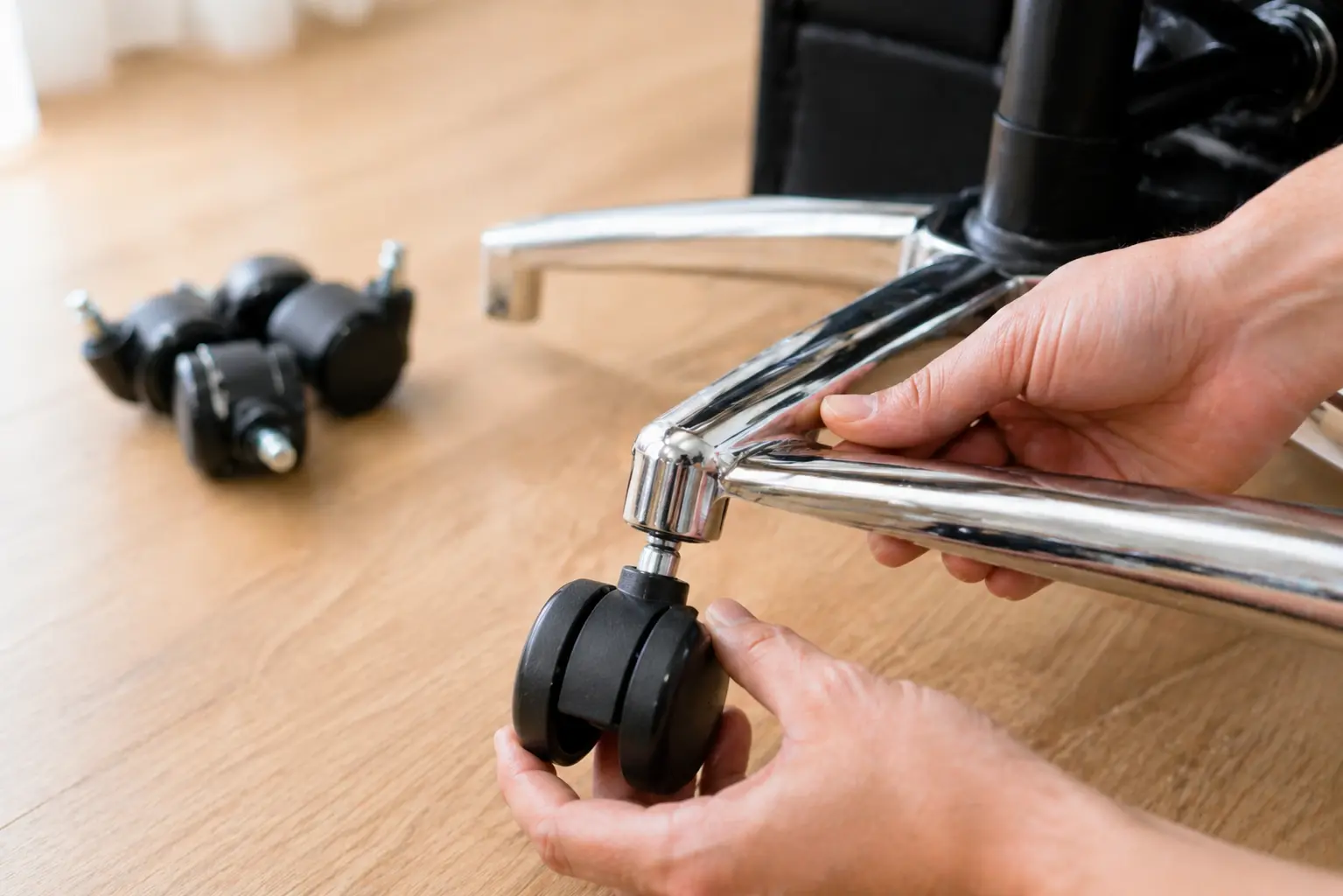
Install the new casters. Align the stem perfectly vertically in the socket and push firmly until you hear a click. Do not force at an angle: oblique pressure can crack the plastic socket of the star base, which would then require replacing the entire base.
Test before standing the chair back upright. Gently shake each caster: it should not wobble. Stand the chair upright, sit down, and make a few movements to validate smoothness, absence of noise, and stability.
If your chair also has a height that will not hold or squeaking from the mechanism, consult our guide on repairing an office chair that creaks or sinks — both operations can easily be done in the same session.
Brand Compatibility: Special Cases
Universal casters cover the vast majority of chairs, but certain models warrant a specific check.
Standard chairs (entry and mid-range, large retailers, Scandinavian brands): 11 mm stem in almost all cases. Universal 11 mm kits will work. Measure anyway before ordering.
High-end ergonomic chairs (Herman Miller, Steelcase, Haworth, Humanscale): these brands offer their own replacement parts. Universal casters may work on older models, but recent versions sometimes have proprietary stems with slightly different dimensions. If in doubt, contact the brand's after-sales service.
Heavy executive chairs (capacity > 120 kg): these require heavy-duty casters with a wheel diameter of 65 to 75 mm and a hardened steel stem. Standard lightweight casters are not designed for these loads and may crack within weeks.
Chairs with an aluminium base: the socket is often more precise than a plastic base. A slightly undersized stem will not hold. Respect the exact diameter.
For situations where repair is no longer sufficient and chair replacement is necessary, our guide on office chair replacement helps you make the right decision based on the condition and use of the seat.
Caster Maintenance: Three Habits to Double Their Lifespan
A new PU caster can last between 5 and 10 years with minimal maintenance. Three simple actions are all it takes.
Clean the axles every 2 to 3 months. Hair and carpet fibres wrap around the central axle and progressively block rotation — this is the number one cause of casters that "seize up" without being broken. Use fine scissors to cut the threads, then a cotton swab to remove residue.
Lubricate once a year with silicone lubricant. One drop per axle is enough. Avoid cooking oil and thick grease: they attract dust and end up blocking the mechanism instead of smoothing it.
Respect the service load. Standard casters support 50 kg per unit (250 kg total for a 5-branch base). For intensive daily use or a user over 100 kg, opt from the outset for heavy-duty casters — they cost $5 more and last two to three times longer.
To complete the full maintenance of your chair, our guide on cleaning an office chair according to its material covers the seat, backrest, and armrests.
FAQ: Replacing Your Office Chair Casters
My casters no longer roll — should I replace them or just clean them?
Start with cleaning. The majority of "blocked" caster cases are caused by an accumulation of hair and fibres around the axle, not a broken part. Remove the casters, cut the tangled threads with fine scissors, wipe the axle, and reinstall. If the rotation remains stiff or uneven after cleaning, replacement is necessary.
How do I check that my new casters are properly fitted?
A correctly installed caster does not move when pulled sideways. It pivots freely through 360° without resistance and without any perceptible vertical play. If it wobbles or produces a clicking sound when you put your body weight on it, it is not fully engaged — remove it and reinsert it while maintaining pressure perfectly perpendicular to the socket.
Can brake casters be installed on a standard chair?
Yes, provided the fitting is compatible (10 or 11 mm stem). Auto-locking brake casters — which lock when you stand up and unlock when you sit down — are available in universal format. They remain uncommon on the market but are particularly useful for elderly or mobility-impaired users, or for working standing up on a slightly inclined floor.
Do PU casters for hardwood floors also work on tiles and vinyl?
Yes. Polyurethane casters are suitable for all hard floors: hardwood, laminate, tiles, vinyl, polished concrete, linoleum. Their soft tread protects all these surfaces without leaving marks. It is the most versatile choice for a home office where the floor type may vary from room to room.
My base has 4 branches — how many casters should I order?
Order according to the exact number of branches. 4-branch bases exist on some older or niche models — they offer less stability than 5-branch bases and are gradually being phased out by manufacturers. Visually check the number of branches before ordering.
Replacing your office chair casters is a quick and economical operation, provided you have made the right choices beforehand. Measuring the stem, identifying the floor type, checking compatibility with your model: three preliminary steps that make all the difference between a successful replacement and a second unnecessary purchase. For under $25 and in less than a quarter of an hour, your chair regains perfect mobility and your floor is finally protected.
Is your seat too worn for a simple repair? Discover our range of professional office chairs to invest in a model built to last.