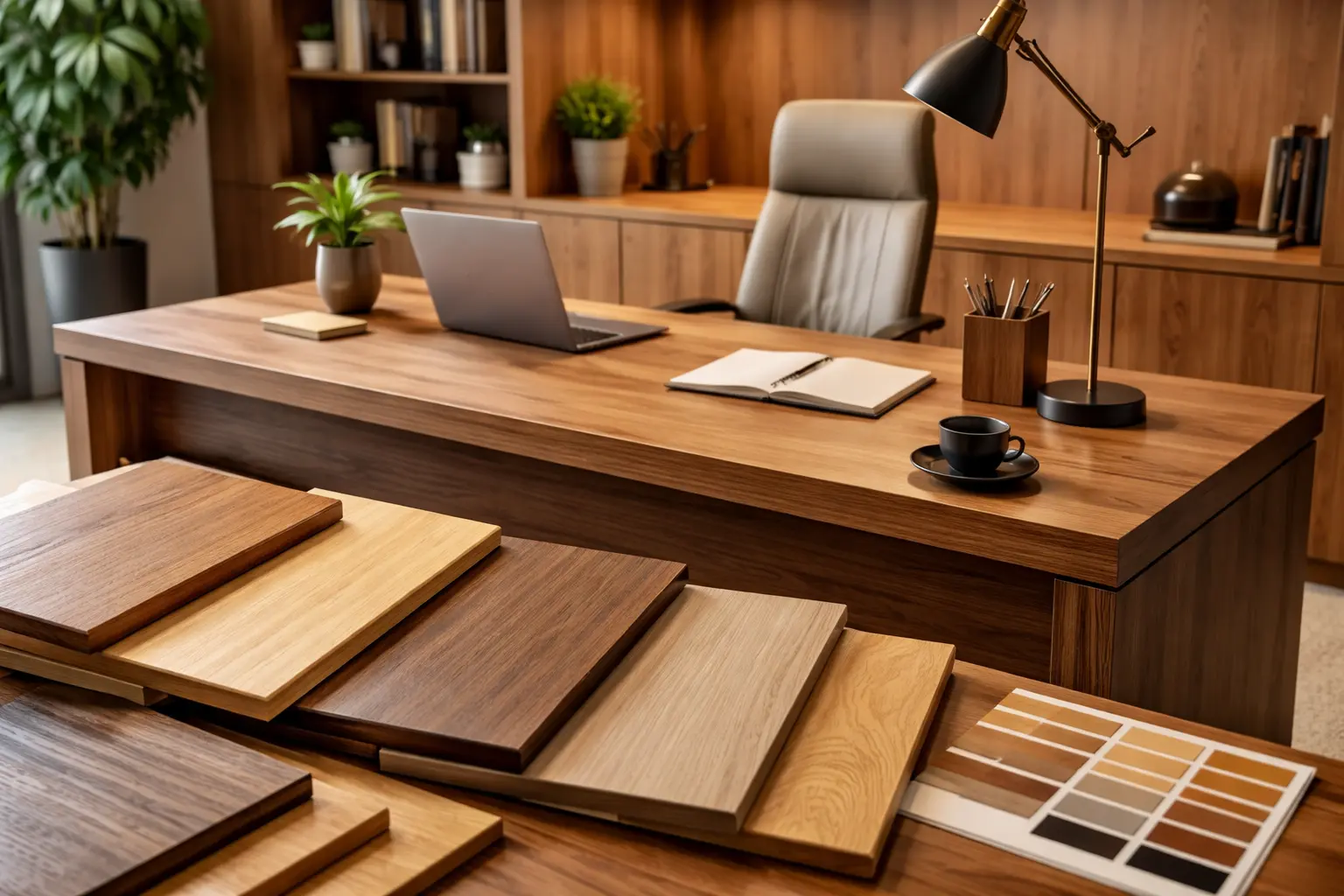
Choosing a natural wood desk for your teams is far more than an aesthetic decision. It is a technical, strategic, and human choice that commits the durability of the furniture, the well-being of employees, and the coherence of the company's CSR approach. Oak, beech, walnut, ash, bamboo — each wood species has its own personality, strengths, and limitations. Each finish determines resistance and daily maintenance requirements. And every millimetre of wood desktop thickness counts when the desk needs to hold up for years under intensive workload.
In France, wood accounts for 47.76% of the office furniture market share in 2024 (Mordor Intelligence), in a sector estimated at $1.75 billion in 2025. This guide gives you all the tools to make the right choices — from wood species to surface treatment — and invest in a solid wood desk that will last.
Why Choose a Natural Wood Desk for Your Professional Spaces
The scientific evidence: wood reduces stress and improves productivity
What intuition long sensed, science now confirms with precision. Several peer-reviewed studies published between 2019 and 2025 establish a direct link between the presence of natural wood in workspaces and measurable improvements in occupant well-being.
A randomized controlled study published in the Journal of Environmental Psychology (ScienceDirect, 2023) measured hair cortisol levels — a biological marker of chronic stress — in employees working in oak-furnished offices versus control spaces without wood. The result: cortisol levels were significantly lower in wood-furnished environments. A systematic review of 74 peer-evaluated studies (Intelligent Buildings International, Taylor & Francis, 2024) confirms that natural materials, including wood, generate measurable psychological, physiological, and cognitive benefits in the workplace.
The aggregated figures are compelling for decision-makers:
- +6% productivity in spaces incorporating natural materials such as wood
- -15% absenteeism in biophilic design environments (EHS Insight, 2024)
- 18% fewer sick days for employees exposed to natural materials and natural light (UK Green Building Council)
To go further on the benefits of ergonomics and well-being at the workstation, our article on workplace ergonomics is the perfect complement to this topic.
A material in service of your CSR approach
A natural wood desk fits naturally into a responsible procurement policy. Wood is a bio-sourced, renewable material that stores carbon and can be repaired — the opposite of melamine panels or laminates that end up in landfill after a few years of use.
Two certifications serve as the benchmark for responsible B2B procurement:
- PEFC (Programme for the Endorsement of Forest Certification): covers primarily European woods (oak, beech, ash, pine). Guarantees sustainable management, traceability, and reforestation.
- FSC (Forest Stewardship Council): certifies extra-European species in particular (acacia, exotic species). Internationally recognized standard accepted by CSR policies.
Requiring these certifications in your furniture tenders is not just good practice — it is a direct response to stakeholder expectations and the spirit of the AGEC Act.
The Best Wood Species for a Professional Desk
Oak: the benchmark for solid wood desks
Oak is the reference species for demanding professional environments. Its high hardness (~1,290 lbf on the Janka scale), wear resistance, and distinctive grain make it the preferred choice for executive offices, prestige meeting rooms, and intensive-use workstations.
What science says about oak specifically: a 2019 study published in Building Research & Information (Taylor & Francis) found that environments furnished in oak produce a stress response (salivary cortisol) lower than that of control spaces. Light-coloured oak, in particular, generates a more pronounced biophilic effect than darker species.
Its strengths for a solid wood desk:
- Longevity: 15 to 20 years with minimal maintenance
- Repairability: can be sanded and re-oiled at any time
- Compatible with all finishes (oil, varnish, wax)
- Available through French or European PEFC-certified supply chains
Best suited to: executive offices, conference tables, high-end workstations.
Beech: versatile and accessible
Beech is oak's understated partner — less spectacular in its grain, but remarkably high-performing. Dense, uniform, with a slightly pinkish light tone, it lends itself to all finishes and suits both contemporary and more classic environments.
Widely cultivated in France (Normandy, Vosges, Jura), beech has a low carbon footprint and consistent availability. Its cost is generally lower than oak, making it an excellent compromise for large-volume fit-out projects.
Key consideration: beech is slightly less moisture-resistant than oak. A quality protective finish (varnish or hard oil) is essential for workstations exposed to humidity variations.
Best suited to: open-plan offices, collaborative work surfaces, high-volume operational desks.
Walnut: prestige in service of leadership
Walnut is the species of understated luxury. Its rich warm brown tone with deep reflections, its fine texture, and its naturally smooth finish make it the material of choice for executive spaces, boardrooms, and carefully appointed company reception areas.
Its technical characteristics: excellent durability, good impact resistance, naturally smooth surface that responds well to oil and varnish. Its only limiting factor: high cost and more restricted availability than oak or beech.
Best suited to: CEO and general management offices, reception rooms, representation spaces.
Ash and Acacia: robustness and contemporary design
Ash combines straight grain, light tone, and excellent mechanical resistance. Widely appreciated in Scandinavian or minimalist furniture design, it adapts to design offices where visual lightness is paramount. Important note: certain ash species face phytosanitary pressures (emerald ash borer) — always verify traceability and PEFC certification of your supply.
Acacia is a surprise: one of the hardest species available for furniture, naturally resistant to moisture and insects thanks to the oils present in the wood. Its modern appearance (varied tones, marked veins) makes it an increasingly popular premium choice for wood desktop surfaces on sit-stand desks, where both robustness and lightness are required.
Best suited to: sit-stand desks, collaborative workspaces, high-use design furniture.
Bamboo: the high-performance ecological alternative
Technically a grass, bamboo deserves its place in this guide. Its Janka hardness (1,180 to 1,380 lbf depending on treatment) exceeds that of European oak. Its scratch and stain resistance is high. And its ecological argument is unbeatable: it regenerates in 3 to 5 years, compared to 50 to 100 years for a hardwood tree.
For companies deploying sit-stand desks in large numbers, bamboo is particularly relevant: lightweight, durable, easy to maintain, and a coherent CSR statement. Its one watchpoint: it must be properly treated to resist humidity variations, especially in air-conditioned environments.
Best suited to: sit-stand desks, agile flex-office workstations, companies with strong CSR policies.
Choosing the Right Finish for Your Wood Desktop
The most beautiful wood desk board can be ruined by a finish unsuited to its use. Here are the four options every buyer needs to master.
Natural oil: preserved authenticity
Hard oil penetrates deep into the wood fibres without forming a surface film. It nourishes, protects, and preserves the natural tactile character of the wood — the sensation of touching the material itself, not a plastic film.
Advantages for professional desks:
- Local repairability: a scratch, an impact? Treat the damaged area without refinishing the entire desktop
- Simple maintenance: diluted black soap for daily cleaning, re-oiling once or twice a year depending on intensity of use
- Authentic matte finish that develops a patina over time
Limitations: lower protection against liquid stains compared to varnish. Best reserved for workstations where accidental spills are rare or quickly wiped up.
Varnish (floor finish): maximum protection for intensive use
Varnish creates a protective surface film — satin to gloss depending on the product — forming a barrier against stains, scratches, abrasion, and moisture.
Ideal for: solid wood desks subjected to intensive daily use (multi-user workstations, high-rotation open-plan offices, reception areas). Protection is maximum and maintenance amounts to simple wet cleaning.
Key consideration: in the event of a deep scratch or impact, the entire surface must be sanded and revarnished — impossible to treat locally as with oil.
Comparative finish table
| Finish | Stain protection | Repairability | Maintenance | Recommended use |
|---|---|---|---|---|
| Natural oil | Moderate | Excellent (local) | Re-oiling 1-2×/year | Executive offices, low-traffic posts |
| Varnish / floor finish | Maximum | Full surface only | Wet cleaning | Open-plan, intensive use |
| Oil-wax | Good | Good | Occasional waxing | Moderate use |
| Wax only | Low | Good | Frequent | Storage units, decorative areas |
Technical Specifications: What Every Professional Buyer Needs to Know
Wood desktop thickness: the guide by use
The thickness of a wood desk board directly determines the rigidity, stability, and lifespan of the desktop. An important physical reminder: rigidity is proportional to the cube of thickness — a 40 mm top is 2.4 times more rigid than a 30 mm top.
| Professional use | Recommended thickness |
|---|---|
| Light use (laptop, writing) | 18-22 mm |
| Standard professional use | 25-30 mm |
| Intensive use (multi-screen, heavy equipment) | 38-40 mm |
25 mm is the optimal compromise for the vast majority of professional workstations: sufficient robustness, controlled weight, reasonable cost.
Load capacity and longevity
A quality solid wood desk can support between 68 and 136 kg depending on the species, desktop thickness, and structural design (distance between legs, presence of cross-rails). For workstations equipped with multiple screens, a docking station, and a printer, plan for a structure with closer-set legs or a central cross-rail.
Properly maintained, a natural wood desktop has an estimated lifespan of 15 to 20 years — compared to 5 to 8 years for a standard melamine desktop. The repairability advantage of solid wood (sanding, refinishing) extends this cycle further, making natural wood the material with the most favourable total cost of ownership in the long term.
For setting up an efficient computer workspace with the right desk configuration, our guide on the computer desk: the perfect furniture for your setup provides complementary recommendations.
Pairing a Natural Wood Desk with an Ergonomic Chair
A quality natural wood desk deserves a chair to match. The common mistake in companies: investing in a carefully chosen solid wood top, then pairing it with an entry-level chair that penalizes the posture and efficiency of employees.
Musculoskeletal disorders account for more than 87% of occupational diseases in France (Assurance Maladie, 2023). A chair poorly adapted to the workstation directly contributes to these conditions, regardless of the quality of the desk. To prevent these risks, our article on ergonomic chairs and MSK disorder prevention lists the essential criteria to check.
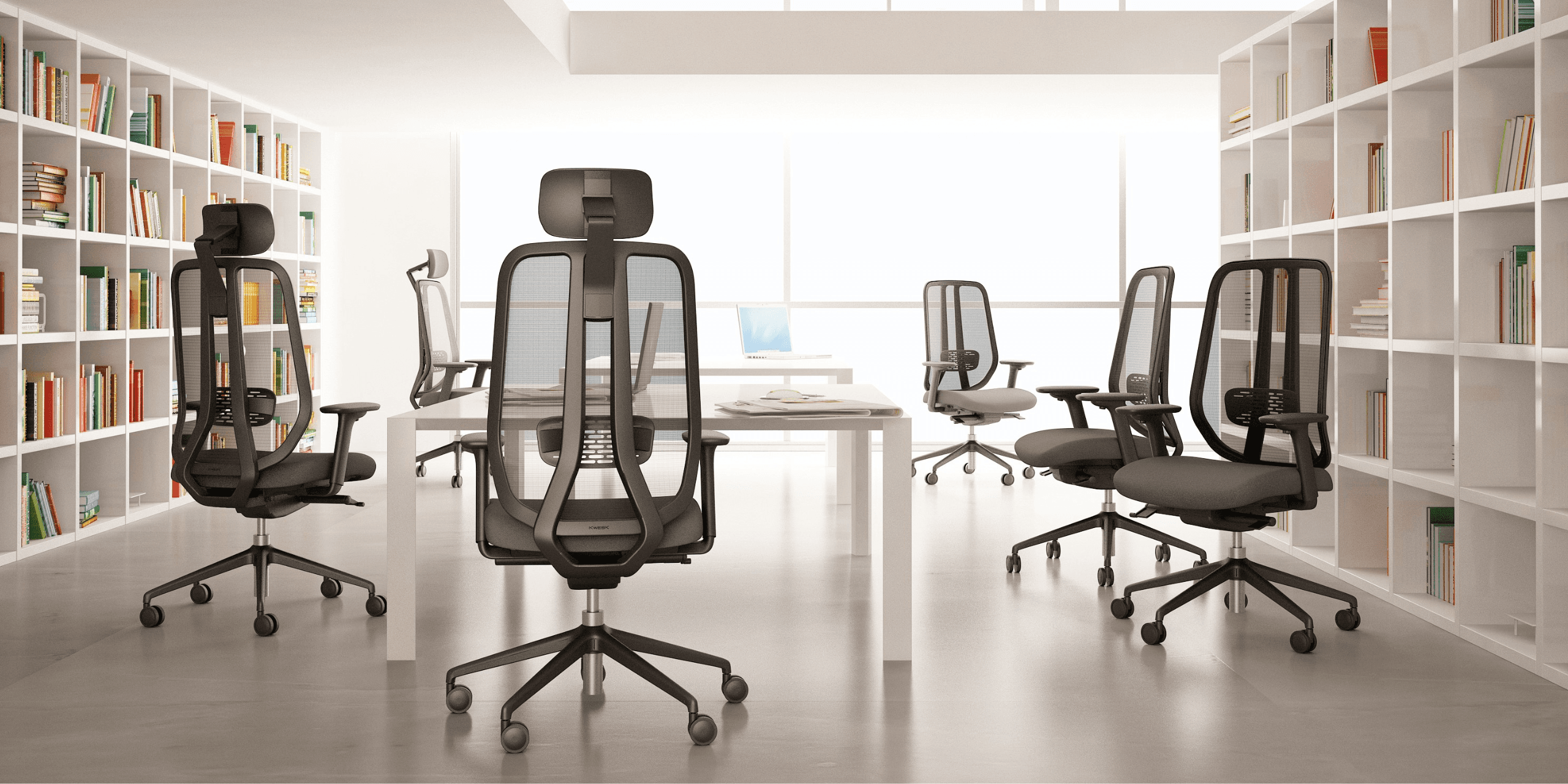
KWESK ranges — designed for intensive use with a 5-year warranty — naturally complement a high-end wood desk:
- The Exclusive range: the ideal executive chair to accompany a walnut or solid oak desk in a prestige space
- The Challenger range: versatile and robust, perfect for open-plan offices furnished in beech or bamboo
- The BY 100 range: designed for long sessions, ideal for sit-stand workstations with acacia or bamboo tops
For a complete overview of your workspace fit-out, consult our guide on professional office furniture which covers all the elements to coordinate.
Conclusion
A well-chosen natural wood desk is an investment that pays off over time — in comfort, productivity, image, and total cost of ownership. Scientific data confirms what field experience teaches: wood reduces stress, improves concentration, and contributes to a work environment where employees feel genuinely well. And professional buyers who master wood species, thicknesses, and finishes avoid the costly mistakes that lead to prematurely replacing undersized furniture.
Oak for durability and prestige, beech for versatility and accessibility, bamboo for ecological performance, walnut for representation spaces — each species has its place. The essential point is to match the wood choice to the actual use of the workstation, and never to separate the quality of the desk from that of the chair paired with it.
Ready to equip your spaces with the right furniture partners?
- Discover the complete range of KWESK ergonomic chairs — designed for intensive use, 5-year warranty, available in 12 countries
- Explore our advice for a successful professional office fit-out from A to Z
- Contact our team for a personalized quote and recommendations tailored to your sector