Your teenager spends hours hunched over textbooks, a computer, or a controller — and the chair they sit in plays a far greater role in their health than you might think. An office chair for teenagers isn't just a piece of furniture: it's an investment in their posture, concentration, and long-term wellbeing. During a period of intense growth, an ill-fitting seat can cause chronic pain that persists well beyond adolescence.
Why Teen Posture Is a Public Health Issue
The numbers are striking. According to a systematic review published in MDPI Healthcare in 2024, between 64.4% and 74.4% of young people will experience low back pain at some point in their lives. Each additional hour spent sitting in front of a screen increases the risk of low back pain by 26%, according to a meta-analysis published in the BMJ in 2025. Your teenager's home workstation deserves serious attention.
"Tech Neck" Is Increasingly Affecting Teenagers
The American Posture Institute reports that 79% of teenagers say they suffer from daily neck pain linked to digital device use. The main cause: the head drifting forward toward the screen when the chair fails to properly support the back.
What's known as "tech neck" is no small matter. When the head tilts forward by just a few centimetres, the effective load on the cervical spine can reach up to 27 kg — the equivalent of carrying a toddler on the back of your neck, for hours on end. With an ergonomic chair designed to prevent musculoskeletal disorders and back pain, this pressure is significantly reduced.
A Spine That's Still Developing
Between the ages of 10 and 18, the lumbar spine (L1–L5) is still forming its natural curve. Intervertebral discs are particularly vulnerable to external pressure during this phase. Prolonged poor posture at this age can lead to permanent sagittal spinal imbalances, confirmed by several recent clinical studies (PMC, 2022–2024).
Unlike an adult whose spine is already set, a teenager who sits badly for years risks that poor posture becoming structural — and irreversible.
Essential Criteria for a Teenager's Office Chair
The market is full of seats marketed as "youth-friendly," but very few genuinely combine all the features that matter. Here's what actually makes a difference.
Height Adjustability: The Absolute Priority
A teenager can grow 5 to 8 cm per year. A fixed-height chair, even if well-sized today, will be inadequate within 18 months. The height adjustment range must cover the entire growth period — ideally between 40 and 53 cm from the floor — to accommodate users from 130 cm to 185 cm tall.
The basic rule: feet flat on the floor, knees bent at 90°, hips slightly higher than the knees. If your teen lets their legs dangle or crosses their ankles under the chair, the height is wrong. For a deeper look at optimising workstation ergonomics, a dedicated guide covers every adjustment in detail.
Lumbar Support: Protecting a Growing Spine
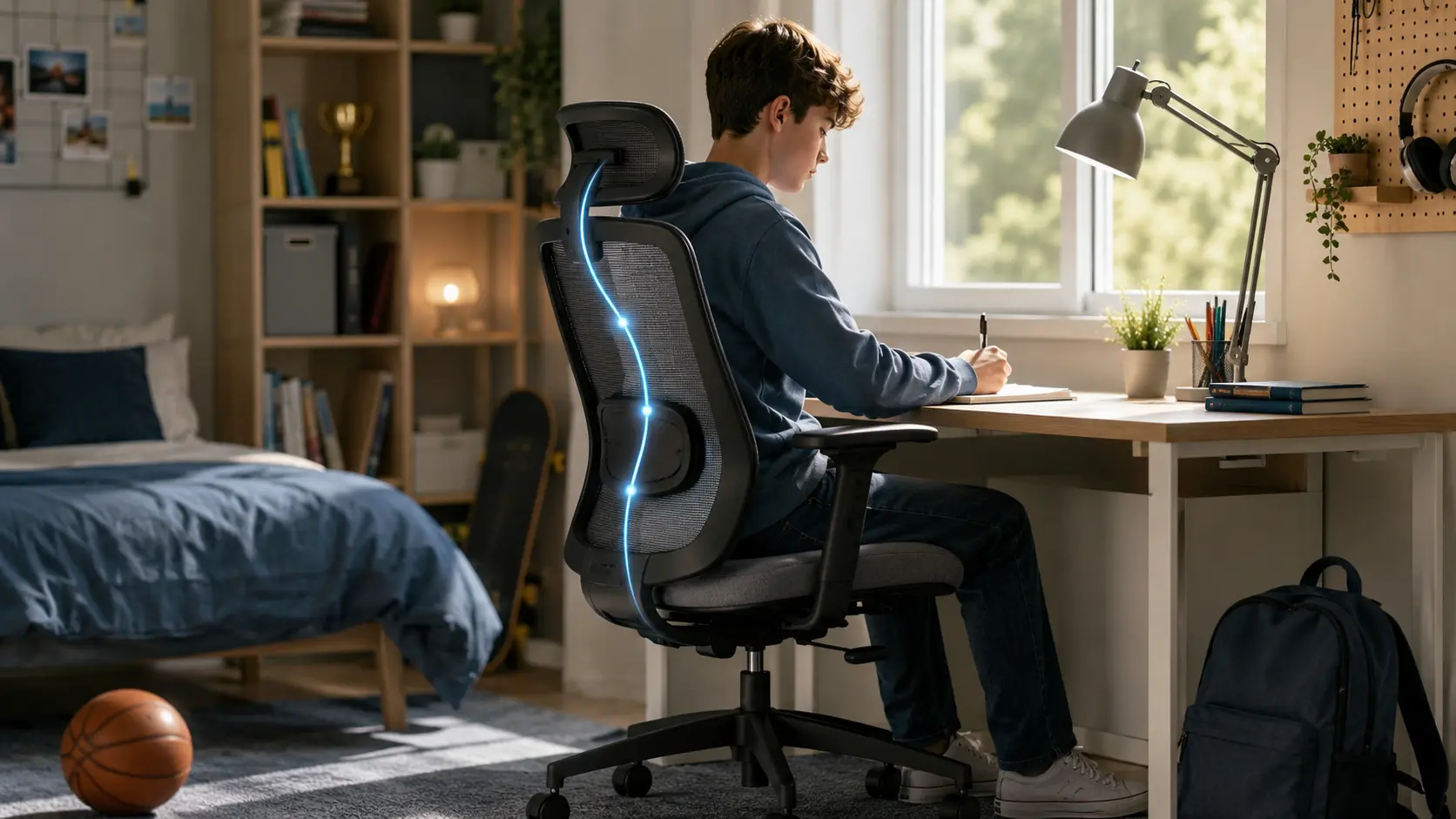
This is the criterion most often overlooked in budget "kids" or "teen" chairs. Adjustable lumbar support targeting the L3 region helps maintain the natural curve of the lower back during long study sessions.
Without this support, teenagers will naturally slump within 20 to 30 minutes — and the back muscles compensate until they're exhausted. A good office chair for back pain relief always includes independent, adjustable lumbar support.
Seat Depth: Often Underestimated
A seat that's too deep pushes the teenager to arch their lower back against the backrest, or to perch on the front edge with no back support at all. The ideal depth leaves 2 to 3 fingers of space between the front edge of the seat and the back of the knee.
This measurement varies with body shape: a 14-year-old and a 17-year-old have very different proportions. Which is yet another reason why seat depth adjustability matters.
Armrests: Relieving the Shoulders
Height-adjustable armrests allow the elbows to rest at the same level as the desk, relieving tension in the shoulders and neck. Ideally, 3D or 4D armrests also offer width and angle adjustment to fit each teenager's build.
Backrest: Supporting the Whole Spine
The backrest should extend from the lower back up to the shoulder blades. A slight recline of 100–110° reduces pressure on the intervertebral discs compared to sitting bolt upright — and supports sustained concentration over time.
Setting Up an Ergonomic Study Station at Home
The chair alone doesn't do everything. For ergonomics to work, the entire workstation needs to be considered as a coherent whole. Our guide on setting up a home office for remote work offers advice that applies directly to a teenager's study corner.
Desk Height
The desk should be at elbow height when your teenager sits with their arms relaxed at their sides. Too high, and the shoulders rise — a direct source of neck tension. Too low, and the teen leans forward. A height-adjustable desk is ideal; otherwise, a footrest can compensate if the chair needs to be raised.
Screen Position
The top of the screen should be at eye level, roughly 50–70 cm from the face. Too low, and the head tilts down — the beginning of tech neck. An inexpensive monitor stand solves this in minutes.
Lighting and Organisation
Poor lighting pushes teenagers closer to the screen. A tidy, organised desk reduces repeated twisting to reach items — a source of lumbar tension that's often overlooked.
How Long Can a Teenager Sit and Study?
Even with the best office chair, staying seated without moving is harmful. Ergonomics experts recommend no more than 30 to 45 minutes of continuous sitting before an active break.
A simple method to apply:
- 20 minutes sitting — maximum focus
- 8 minutes standing or in a different position
- 2 minutes of movement — stretches, walking, light activity
For eye health, the 20-20-20 rule is particularly useful for teenagers who combine school work on a screen with social media use: every 20 minutes, look at something 6 metres away for 20 seconds.
Recent studies show that study or gaming sessions lasting more than 3 to 5 hours without a break are directly linked to the development of tech neck in teenagers (The American Chiropractor, 2024).
Choosing by Age and Body Type
There's no universal chair for all teenagers. The right approach is individual.
For Pre-Teens (Ages 10–13)
At this age, size is the priority: many adult chairs are simply too large. Look for a chair with a minimum seat height of 38–40 cm and a shorter backrest. Adjustability already matters here, as growth is rapid.
For Teenagers (Ages 14–17)
Body proportions are closer to those of an adult. A professional ergonomic office chair can work well, provided the height is correctly set and the lumbar support is adjustable. At this age, durability and robustness also become key criteria — the chair must withstand intensive daily use.
For Older Teenagers (Ages 17–18)
They can use a standard adult office chair. Our best office chairs for 2026 comparison can help you select a model that will continue to serve them through higher education.
Practical Tips to Encourage Good Posture
Having the right chair is necessary, but not sufficient. Here's how to build lasting good posture habits in your teenager.
- Lead by example: if your teen sees you using an ergonomic chair and taking regular breaks, they're more likely to adopt those habits themselves.
- Explain the why: teenagers respond better when they understand the concrete consequences — future pain, poorer concentration, increased fatigue.
- Use a posture checklist: feet flat on the floor, back against the backrest, screen at eye level, shoulders relaxed. Pin it above the desk.
- Set reminders: an alarm every 30 minutes to stand up and move. Many productivity apps now include this feature.
- Invest in the right equipment from the start: a quality chair lasts 5 to 10 years. Spread over that time, the cost is far lower than osteopathy or physiotherapy bills.
For more guidance on choosing the right seat, our complete guide on how to choose the best office chair covers every decision point. You can also compare the differences between office chairs and executive armchairs to refine your choice.
Conclusion
An office chair for teenagers is far more than a piece of school furniture. During a critical growth period, it directly influences spinal health, quality of concentration, and postural habits that will last a lifetime. Between 64% and 74% of young people will suffer from low back pain at some point — often because their work environment was never designed with them in mind.
The essential criteria to remember: height adjustability, adjustable lumbar support, appropriate seat depth, and positionable armrests. A durable chair built for intensive use protects your teenager today and stays with them through the end of their studies.
KWESK designs ergonomic seats built for intensive work environments, backed by a 5-year warranty that reflects their quality. Explore our Gamma, Challenger or Corpo ranges, or contact our team for personalised advice based on your teenager's profile and build.