![Office Fit-Out Projects: Management and Planning Guide [2026]](/_next/image?url=%2Fblog%2Fprojets-amenagement-bureau-guide-gestion-planification.webp&w=3840&q=75&dpl=dpl_3FZFsqVba4ifUzH83EiWnXVfqXHh)
Managing office fit-out projects is far more than choosing furniture and a paint color. It is a strategic investment that directly impacts team productivity, employee well-being, and the company's image. Yet according to the Project Management Institute, 39% of projects fail due to inadequate planning. Whether you are overseeing the reorganization of a few workstations or a complete office floor redesign, this guide gives you the method, tools, and budget benchmarks to bring your office fit-out project to completion — on time and without unpleasant surprises.
Why Structuring Your Office Fit-Out Project Matters
A poorly managed fit-out project almost guarantees budget overruns, construction delays, and a final result that misses the real needs of your teams. A well-run project, on the other hand, delivers lasting benefits.
Companies that optimize their work environment see an average 17% increase in team productivity (Source: Steelcase, 2025). With hybrid work now mainstream, the office has become a strategic tool in its own right: it must foster collaboration, reflect company culture, and adapt to constantly evolving ways of working.
Structuring your office fit-out project from the start means:
- Setting clear, measurable objectives
- Allocating a realistic budget and sticking to it
- Coordinating contractors without friction
- Delivering a functional space that truly meets users' needs
Phase 1: Scoping and Needs Analysis
The first phase of an office fit-out project is the most decisive — and often the most neglected. Before drawing a floor plan or consulting suppliers, you need to understand how your teams actually work.
Auditing the Existing Space
Start with an objective analysis of the current space:
- Actual occupancy rate: how many workstations are genuinely used each day? Badge data or occupancy sensors over 2 to 4 weeks provide a reliable picture.
- Pain points: what are the recurring complaints from employees? Noise, lack of meeting rooms, unsuitable workstations, poor lighting?
- Work patterns: what proportion of time is spent in focused individual work versus collaboration? How many days per week are teams in the office?
Gathering User Requirements
Involving employees from this phase is essential. A fit-out project that ignores team needs generates resistance to change and underused spaces. Five targeted questions are enough to collect the essentials:
- What types of tasks do you perform most often?
- What spaces do you need that you currently don't have?
- What most hinders your concentration or comfort?
- How do you collaborate with colleagues on a daily basis?
- What type of environment best supports your productivity?
Defining Project Objectives
Based on the audit and team feedback, formalize precise objectives. Examples:
- Reduce noise in focused individual work zones
- Increase informal collaboration spaces by 30%
- Accommodate 20% more workstations without expanding the floor area
- Improve ergonomics at 100% of fixed workstations
These objectives will serve as the guiding thread for every decision throughout the project.
Phase 2: Planning and Design
Once needs are clearly defined, fit-out planning can begin. This is the core work of the office fit-out project manager.
Setting the Overall Budget
The budget is the parameter that drives all other decisions. In 2026, office fit-out costs in France typically fall within the following ranges:
- Basic fit-out (flooring, paint, decoration): €200 to €500/m²
- Full quality fit-out: €600 to €1,200/m²
- Heavy renovation with structural works: €1,000 to €2,500/m²
- Premium fit-out (Paris, high-end finishes): up to €2,300/m² and beyond (Source: Cushman & Wakefield, 2025)
Golden rule: always set aside a contingency reserve of 10 to 15% of the total budget for unexpected costs. On a fit-out site, surprises are common — hidden technical constraints, supplier delivery delays, last-minute changes.
Do not forget to include in your budget:
- Contractor fees (interior architect, engineering firm, project manager)
- Furniture and equipment
- Works (electrical, plumbing, partitions, finishes)
- Signage and decoration
- Relocation and transitional management costs
Choosing the Right Contractors
Project quality depends heavily on your partners. Depending on the project size, you may involve:
- An interior architect: for projects over 1,000 m² or with significant design requirements
- A fit-out designer: for mid-sized projects, with a turnkey approach
- A space planner: specialist in surface optimization and workflow organization
- Specialist trades: electricians, plumbers, carpenters, painters
For a successful professional office fit-out, select contractors based on sector references, a clear methodology, and budget transparency. Request at least three comparative quotes.
Establishing the Project Schedule
A realistic schedule is the backbone of any office fit-out project. Key phases and typical durations:
| Phase | Estimated Duration |
|---|---|
| Audit and scoping | 2 to 4 weeks |
| Design and floor plans | 4 to 8 weeks |
| Consultations and quotes | 2 to 4 weeks |
| Obtaining permits | 2 to 6 weeks |
| Fit-out works | 4 to 12 weeks |
| Furniture delivery and installation | 2 to 4 weeks |
| Relocation and handover | 1 to 2 weeks |
Total: budget an average of 4 to 6 months for a complete mid-sized fit-out project. Always allow 5 to 10% extra time on each work package to absorb unforeseen events without jeopardizing the overall schedule.
Phase 3: Execution and Site Management
The execution phase is where the project comes to life — and where the risk of going off-track is highest.
The Role of the Office Fit-Out Project Manager
The office fit-out project manager is the cornerstone of this phase. Their responsibilities:
- Coordinate all contractors and ensure the correct sequence of interventions
- Track progress against the schedule and budget
- Manage arbitrations in the event of unexpected issues or changes
- Communicate regularly with management and the teams involved
- Accept completed work package by package and validate compliance
In companies without a dedicated internal fit-out project manager, this role is often assigned to the facilities manager, HR director, or an external service provider. Whatever the configuration, one person must have both the authority and the availability to drive the project on a daily basis.
Coordinating Trades and Contractors
One of the most common mistakes in office fit-out project management is hiring several separate companies without central coordination. The result: overlapping interventions, cascading delays, and disputes over responsibilities.
Plan weekly site meetings with all contractors, systematic meeting minutes, and a shared progress tracking dashboard. Simple tools such as a shared Excel file or project management software (Trello, Asana, Monday) allow everyone to monitor progress in real time.
Managing Changes During Construction
Changing a material or adjusting a layout once work has started may seem minor — it rarely is. Every change creates cascading consequences: re-pricing, procurement lead times, contractor schedule reorganization. Establish a formal change approval process from the outset, with a systematic assessment of budget and timeline impact before any decision is made.
Phase 4: Furniture, Ergonomics, and Equipment
Furniture typically represents 25 to 40% of the total office fit-out project budget. It is also the element with the most direct and lasting impact on employee well-being and productivity.
Choosing Furniture Suited to Different Uses
A high-performing office layout is built on a diversity of spaces:
- Individual workstations: designed for concentration, with height-adjustable desks where possible
- Collaboration areas: modular tables, informal seating, co-working zones
- Meeting rooms: flexible configurations to suit different team sizes
- Break areas: essential for cognitive recovery between intense work sessions
For each zone, define priority criteria: acoustics, flexibility, durability, aesthetics. Avoid the common mistake of selecting furniture based solely on appearance while overlooking functionality.
Workstation Ergonomics: a Non-Negotiable Priority
In any office fit-out project, workstation ergonomics must be treated as an absolute priority — not an afterthought. Musculoskeletal disorders (MSDs) account for 87% of recognized occupational diseases in France and generate considerable direct and indirect costs for businesses.
An ergonomic workstation includes:
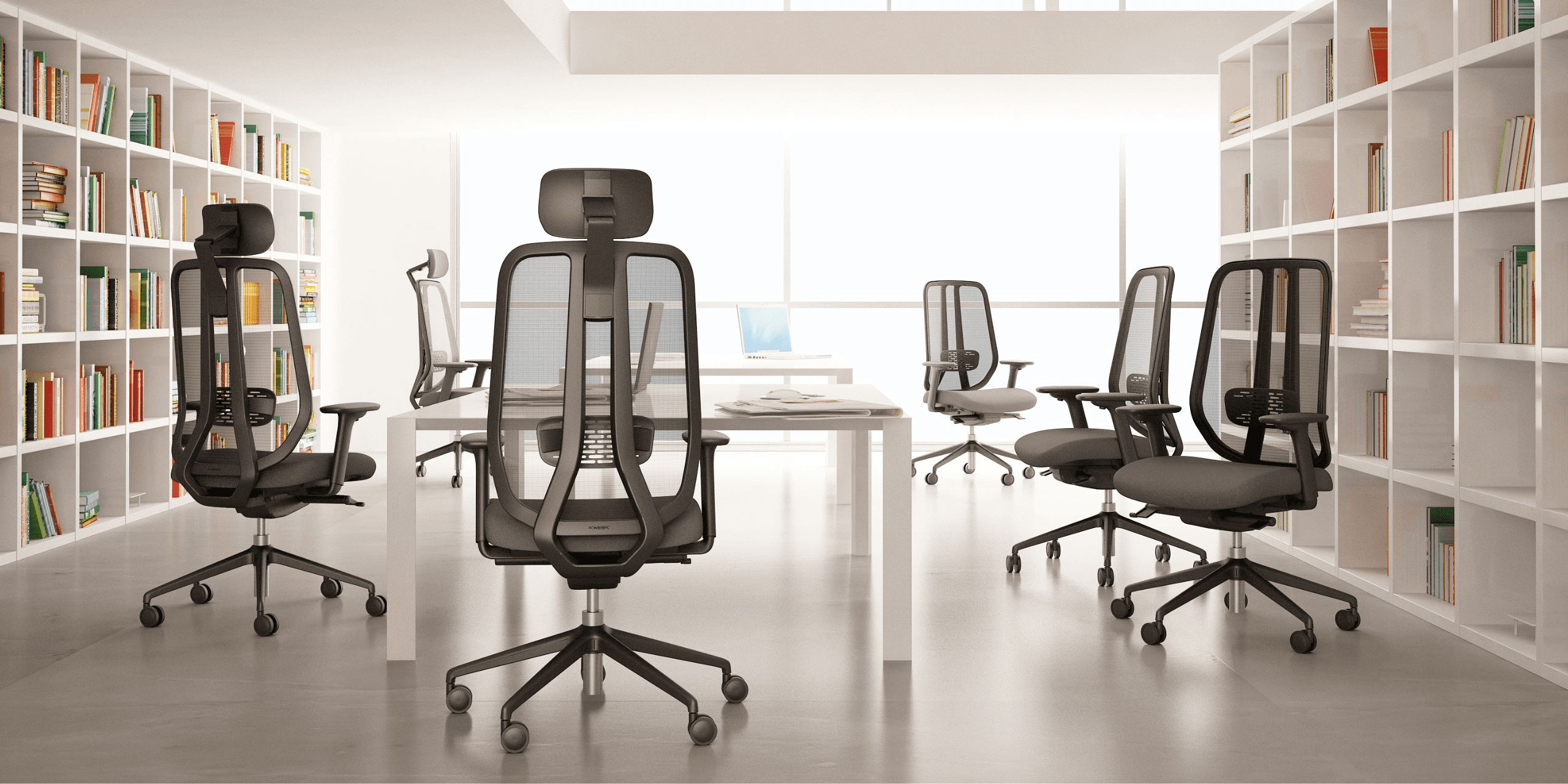
- An adjustable ergonomic chair with lumbar support, adjustable armrests, and a headrest
- A desk at the correct height (height-adjustable, ideally)
- A correctly positioned screen (appropriate height and distance)
- Adapted lighting (natural light as a priority, supplemented by quality artificial lighting)
Explore the key principles of an ergonomic workstation to ensure every employee works in a healthy and high-performing environment.
Selecting the Right Office Chairs
Chair selection deserves particular attention in your fit-out project. At KWESK, our ergonomic office chairs are built for intensive daily use with a 5-year warranty — a decisive criterion for professional office equipment projects.
For individual workstations in intensive use, the Gamma and the Corpo 100 deliver an excellent balance of ergonomics, durability, and value for money. For executive and client-facing positions, the Exclusive range combines premium comfort with a professional design.
Our guide on ergonomic office chairs helps you select the right models for each user profile in your organization.
Mistakes to Avoid in Your Office Fit-Out Project
1. Starting Without a Needs Analysis
The most costly mistake: designing a space without first auditing actual usage patterns and collecting team requirements. The result: spaces that are unsuitable, underused, or need to be redesigned within 18 months.
2. Underestimating the Budget
An underestimated budget from the outset inevitably leads to painful trade-offs mid-project: compromising on furniture quality, abandoning necessary works, or exceeding the initial budget and the tensions that creates. Build your budget from real per-square-meter costs, not rough estimates.
3. Neglecting Change Management
A new office also means a change in working patterns for employees. Without communication and team involvement throughout the project, you risk resistance to change that undermines adoption of the new space. Organize presentation sessions, site visits, and communicate regularly on progress.
4. Overlooking Regulatory Requirements
Every office fit-out project is subject to regulations: accessibility standards, fire safety regulations, acoustic norms, and labor code requirements. Do not address these as a last resort — anticipate them from the design phase to avoid costly modifications during construction.
5. Ordering Furniture Last
Furniture must be selected and ordered during the design phase, not at the end of the construction phase. Delivery lead times for professional office furniture can reach 8 to 12 weeks. A furniture delivery delay can block the space from being put into service and disrupt the entire organization.
Office Fit-Out Project Checklist
Before launching your project, verify that you have:
Scoping phase
- Usage audit and occupancy rate analysis completed
- User requirements collected and analyzed
- Project objectives formalized and validated by management
- Overall budget defined with contingency reserve (10–15%)
Planning phase
- Contractors selected (architect, fit-out designer, trades)
- Detailed schedule established with milestones and owners
- Regulatory requirements identified
- Change approval process defined
Execution phase
- Fit-out project manager designated
- Weekly site meetings scheduled
- Shared progress dashboard set up with all contractors
- Internal communication plan in place
Furniture & ergonomics phase
- Furniture selected and ordered with sufficient lead time
- Ergonomic standards integrated at every workstation
- Diversity of spaces (focus, collaboration, break) planned
Conclusion
A successful office fit-out project is the result of a rigorous methodology: a thorough needs audit, realistic planning, day-to-day management, and constant attention to workstation ergonomics. Whatever the size of your project, these four phases — scoping, planning, execution, equipment — form the essential framework for delivering a workspace that matches your company's ambitions.
At KWESK, we support companies in equipping their professional offices ergonomically, from our headquarters in Casablanca, with deliveries to 12 countries. Our office chairs carry a 5-year warranty and are built to meet the demands of intensive daily use. For a complete, high-performing office fit-out, explore our full range at kwesk.com or contact our team for personalized advice and a quote tailored to your project.