An office chair that squeaks with every movement or sags under your weight isn't necessarily headed for the bin. In 8 cases out of 10, the issue comes from a loose screw, a poorly lubricated mechanism or a worn gas lift — and the repair takes between 10 and 30 minutes with common equipment.
This guide shows you how to pinpoint exactly where the noise or sagging comes from, which products to use, and when it becomes more cost-effective to replace the chair rather than keep fighting it.
Why does an office chair start squeaking?
A standard office chair undergoes between 30,000 and 50,000 micro-movements per year: tilting, rotation, height adjustment, armrests. Each joint contains metal parts, bearings, springs and sometimes plastic bushings that wear down and shift slightly over time.
According to a 2024 survey by the French Office Furniture Federation, 62% of professional chairs develop an abnormal noise from the third year of use, most often due to simple lack of maintenance. Contrary to popular belief, a squeak is almost never a sign of a serious failure: it's a weak signal that must be addressed quickly before wear becomes irreversible.
Bottom line: a squeaking chair won't "fix itself." The longer you wait, the more the parts deform from dry friction, and the more expensive the repair becomes.
Diagnosis: pinpoint the noise precisely
Before grabbing the lubricant spray, you need to know where the noise comes from. Sit in your chair and reproduce the movements one by one, in a quiet office:
- Rock backwards and forwards: if the noise appears here, it's the tilt mechanism or the rocker spring.
- Swivel on yourself: a rotational squeak comes from the gas lift bearing.
- Adjust the height: a whistle or squeak indicates a clogged or worn cylinder.
- Roll on the castors: a clicking sound comes from the wheel bearings.
- Press on the armrests: a crack comes from screws or internal plastic.
Write down on paper the exact source of the noise. In 70% of cases, you'll have identified the faulty part before dismantling anything.
Solutions for the 5 most common squeaks
1. Tilt mechanism that squeaks
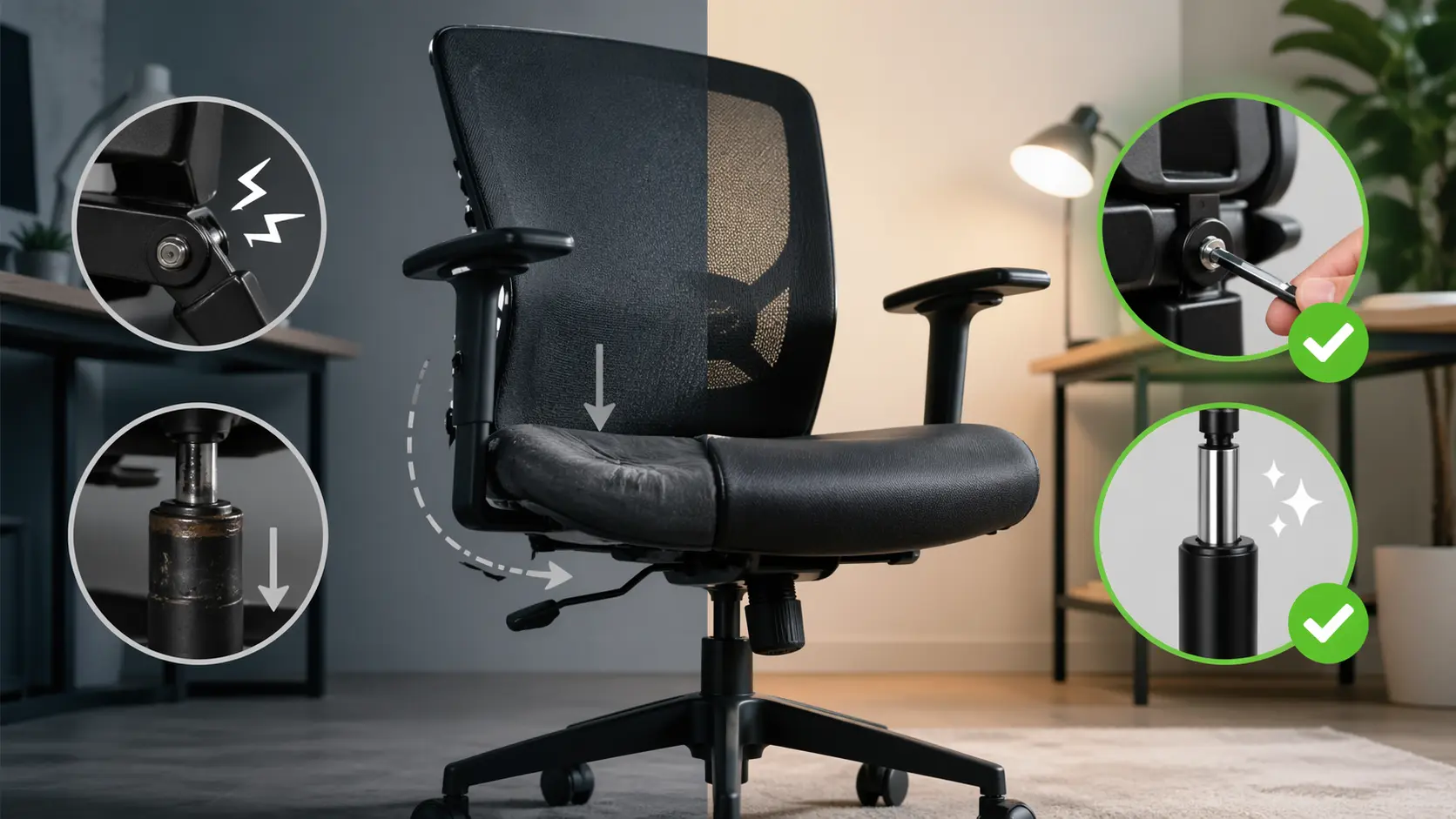
This is problem number one. The mechanism under the seat contains one or two tension springs and metal axles that dry out.
Solution:
- Flip the chair onto a table (mind the gas lift).
- Locate the metal mechanism between the seat and the base.
- Spray a silicone or Teflon lubricant (avoid standard WD-40 which attracts dust) onto the visible axles and springs.
- Operate the tilt 20 to 30 times to spread the product.
- Wipe away any excess with a cloth.
Cost: silicone spray around €7. Duration: 10 minutes.
2. Gas lift that whistles or drops
The gas lift (the telescopic rod under the seat) is the most stressed part. When it squeaks during height changes, it's often dust infiltrated around the piston.
Quick solution:
- Remove the plastic cover from the cylinder.
- Clean the rod with a microfibre cloth lightly dampened with isopropyl alcohol.
- Apply a thin layer of silicone grease to the rod.
- Adjust the height 10 times in a row to spread it.
When to replace: if the seat no longer holds a high position, drops on its own under your weight, or you hear a continuous "hiss," the cylinder is dead. Replacement costs between €25 and €60 depending on load capacity, and takes 15 minutes with a rubber mallet. For a business, consider ordering reinforced cylinders certified class 4 (BIFMA standard) for intensive-use seats.
3. Castors that click or block
Castors accumulate hair, lint and staples around their axle. The result: they roll poorly, catch and emit a clack at every move.
Solution:
- Flip the chair upside down.
- Pull firmly on each castor to extract it (no tool needed on 95% of models).
- Cut away wound hair with scissors or a cutter.
- Clean the axle with a cloth and a drop of alcohol.
- Apply a drop of silicone grease to the axle.
- Re-insert by pushing until you hear a click.
Cost: €0 for cleaning, €15 to €30 for a full set of 5 castors if broken.
4. Armrests that crack
A crack every time you press on the armrests usually comes from loose internal screws or worn plastic bushings.
Solution:
- Remove the cap under the armrest (often clipped).
- Retighten the central screw with a 4 or 5 mm Allen key.
- If the noise persists, fully dismantle the armrest and apply a little silicone grease on the rubbing plastic parts.
If the armrests are cracked or broken, most professional models allow unit replacement. Contact the manufacturer with the chair's reference.
5. General noise from the base or star
A squeak that seems to come "from everywhere" is often due to the star base loosening from its cylinder. Remove the seat and cylinder, check that the base isn't cracked (serious problem, replacement required), clean the tapered mount, and reassemble by striking sharply with a rubber mallet.
For a thorough diagnosis, our guide to cleaning office chairs by material usefully complements these mechanical operations while preserving the upholstery as well.
Why does an office chair sag?
An office chair that sags has two very different symptoms, which shouldn't be confused:
- The seat drops on its own when you sit down: the gas lift has lost its pressure.
- The seat sinks but keeps its height: the internal foam is compressed.
Case 1: faulty gas lift
The gas lift contains pressurised nitrogen. Over the years (3 to 7 years depending on use intensity) and especially with impacts, the sealing joint lets the gas escape. No repair is possible: the part must be replaced.
Replacement procedure:
- Flip the chair and remove the 4 screws securing the mechanism to the seat.
- Strike the cylinder laterally with a rubber mallet to separate it from the base (it may resist strongly).
- Insert the new cylinder the right way up (wide part at the bottom).
- Reassemble the mechanism and seat.
- Sit down: your weight will finalise the tapered fit.
Pro tip: note the cylinder's load class (usually marked in kg on the rod). For use over 8 hours a day, choose a class 4 cylinder supporting at least 150 kg.
Case 2: compacted seat foam
After several years, the polyurethane foam of the seat loses its density and no longer returns to its original shape. You then feel the metal or wooden frame through the seat.
Replacing the foam alone costs around €40 to €80 depending on size, but sometimes requires fully removing the seat cover. On an entry-level chair, it's often more cost-effective to consider a full chair replacement. On a high-end model with a long warranty, contact the manufacturer directly.
Case 3: faulty locking mechanism
Less common, but possible: the wheel under the seat that locks the height is broken or improperly engaged. Check that it is indeed in the "locked" position before considering a replacement.
The right products to lubricate a chair
Not all lubricants are equal. Here's what to use and what to avoid.
Recommended:
- Silicone grease spray: perfect for mechanisms and metal axles, doesn't drip, doesn't attack plastic.
- Teflon (PTFE) grease: ideal for heavily stressed joints.
- Light machine oil: for visible springs.
Absolutely avoid:
- Standard WD-40: it's a penetrant, not a durable lubricant. It attracts dust and hardens in 2 weeks.
- Cooking oil, Vaseline: they go rancid and stain.
- Automotive grease: too thick, clogs mechanisms.
To lubricate an office chair properly, one rule only: apply a thin layer, move the part, wipe off the excess. Too much product attracts three times more dirt.
Basic tools to repair an office chair
To repair an office chair without complicating your life, all you need is:
- A set of Allen keys (2 to 6 mm)
- A Phillips screwdriver
- A rubber mallet (€5 to €15)
- A silicone grease spray
- Microfibre cloths
A complete "pro chair repair" kit costs less than €40 and can maintain 20 to 30 chairs for several years. For an open-space fleet, it's an investment paid back after the first avoided intervention.
When should you give up and replace the chair?
Some signs don't lie. It's time to replace if:
- The star base is cracked: risk of sudden failure, not repairable.
- The backrest shell is broken: impossible to consolidate durably.
- Several parts fail simultaneously: the cumulative repair cost exceeds 50% of the price of a new chair.
- The chair is over 10 years old and no longer meets current ergonomic standards (increased risk of lower back pain for employees).
In these cases, favour a model designed for intensive use with a long-term warranty. The Challenger or Exclusive ranges are tested for more than 100,000 cycles and come with the KWESK 5-year warranty on mechanical parts.
Prevention: 4 habits to avoid the problem
Chairs that never squeak are the ones that are regularly maintained. Adopt these 4 reflexes:
- Every 3 months: retighten all visible screws (base, armrests, mechanism).
- Every 6 months: clean the castors and lubricate moving parts.
- Once a year: inspect the gas lift and check the stability of the base.
- At all times: avoid sitting down abruptly and don't exceed the maximum load indicated.
To further explore how to choose a durable seat, our ergonomic chair comparison details the technical criteria that guarantee superior longevity.
Conclusion: 80% of squeaks are solved in 15 minutes
An office chair that squeaks is almost never fatal. In the vast majority of cases, a methodical diagnosis, a silicone spray and a turn of a screwdriver are enough to restore a silent, comfortable seat. The key is to act as soon as the first noises appear, before mechanical wear becomes structural.
At KWESK, we design professional office chairs built to last, with replaceable mechanical parts and a 5-year warranty. For a personalised diagnosis or a quote to renew your fleet, contact our advisors — every year we help hundreds of companies extend the life of their chairs and choose models tailored to their intensity of use.