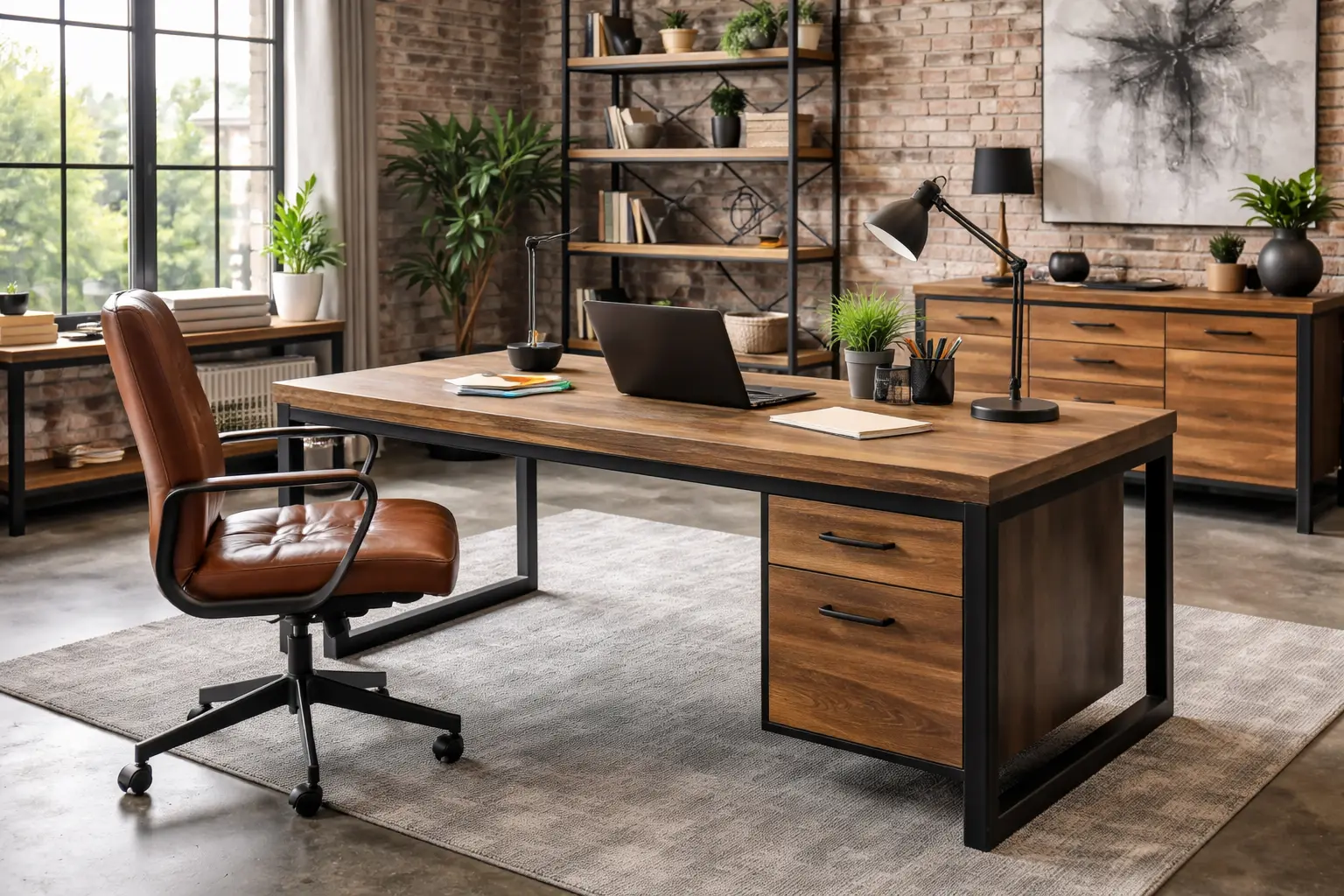
Wood and metal furniture has established itself in just a few years as the signature of the most inspiring contemporary workspaces. From loft-style start-ups to the headquarters of established corporations, this combination of materials defines an instantly recognizable style — raw, solid, authentic — while meeting the strictest demands of intensive professional environments. Far from being a passing trend, wood metal office furniture responds to a deep functional logic: durability, modularity, and aesthetics in service of collective performance.
With the European office furniture market valued at $36.41 billion in 2024 (Mordor Intelligence) and growing demand for workspaces that are both functional and distinctive, decision-makers and procurement managers have every reason to understand what this type of furniture can bring to their organization. This guide gives you the keys to making the right choices.
Why Wood and Metal Furniture Is Dominating Modern Offices
An industrial aesthetic that speaks to your brand
The industrial style — raw wood, exposed metal frames, open spaces — goes beyond decorative effect. It conveys values: modernity, transparency, character. Values particularly appreciated in tech, consulting, design, media, and finance sectors, where the work environment has become a recruitment argument in its own right.
The numbers confirm it: 73% of employees consider the quality of their workspace a determining factor in their choice of employer (HR sources, 2024). And 88% of French employees attach significant importance to quality of working life and conditions. In this context, a well-chosen industrial wood metal furniture piece is not an aesthetic expense — it is an investment in attractiveness.
To explore current industrial style trends in business environments, our article on industrial furniture trends in offices offers an in-depth analysis of the codes and practical applications.
Technical performance beyond appearances
The success of wood and metal furniture in professional environments is primarily due to its intrinsic qualities. The metal frame — lacquered steel, wrought iron, or aluminum — provides exceptional structural rigidity, resisting impacts, daily wear, and frequent moves. The wood top, solid or engineered, adds both visual warmth and tactile comfort, while naturally absorbing vibrations and ambient noise.
This material complementarity produces a result that neither all-metal nor all-wood furniture can achieve alone: a piece that is simultaneously robust, pleasant to use, and visually impactful.
The Benefits of Wood Metal Furniture for Professional Spaces
Durability and resistance to intensive use
In a professional context, furniture is subjected to far greater demands than in residential settings. Wood metal furniture precisely meets these requirements:
- Treated metal (stainless steel, epoxy paint) resists corrosion, scratches, and heavy loads — ideal for high-use workstations or busy circulation areas
- Solid wood, properly maintained, can last several decades without structural degradation. Unlike melamine panels, it can be renovated (sanding, re-oiling) rather than replaced
- The combination of both materials optimizes the furniture's life cycle: where wood wears, you renovate; where metal scratches, you repaint. Result: a total cost of ownership significantly lower over 10 years
Buying tip: prefer bolted rather than glued assemblies for wood-metal structures. This makes repairs and replacement of individual parts easier without having to replace the entire piece.
Acoustics: wood as an unexpected ally of silence
This is the least obvious advantage, but one of the most strategic: wood is a natural acoustic absorber. In open-plan offices and open-floor workspaces, hard surfaces (glass, metal, concrete) amplify ambient sounds and create chronic noise nuisance.
The reality is concerning: 58% of employees report that ambient noise negatively affects their efficiency and well-being at work (National Institute for Research on Work and the Environment, 2024). Integrating wood metal furniture — wood tops, perforated wood partitions, wood storage units — helps absorb these parasitic sounds and reduce reverberation without resorting to costly acoustic solutions.
Modularity and flexibility for the hybrid office
70% of companies have adopted a hybrid organization (CBRE, 2024), with spaces whose occupancy rates vary considerably from day to day. In this context, furniture modularity becomes an operational priority.
Industrial wood metal furniture is perfectly suited to this flexibility:
- Metal frames enable modular configurations (stackable tables, adjustable legs, connectable elements)
- The controlled weight of wood-metal pieces facilitates quick moves and reconfigurations
- The consistent aesthetic of the industrial style ensures visual harmony even during partial refits
Our guide on professional office fit-out details the best strategies for designing flexible, evolving spaces.
How to Choose Your Wood and Metal Office Furniture
Desks and work surfaces
The desk is the centrepiece of any workspace. For a wood and metal furniture piece of professional quality, check these criteria:
- Wood top thickness: minimum 25 mm for intensive use, ideally 30-35 mm in solid oak or beech
- Metal leg section: opt for square profiles of at least 40x40 mm to guarantee stability under equipment load (screens, computers, documents)
- Surface treatment: natural oil or hard varnish for wood (stain and moisture resistance), epoxy paint or powder coating for metal
- Cable management: check for integrated cable grommets or under-top cable trays — essential in a digital work environment
Recommended dimensions: minimum 160 cm width for dual-screen workstations; 80 cm depth for optimal working comfort.
Storage: pedestals, shelving, and partitions
Well-planned storage is the foundation of an efficient, organized workspace. In a wood metal furniture décor, storage can become a powerful decorative element:
- Open shelving units in wood on metal frames: functional and visually impactful, they structure the space without enclosing it
- Mobile pedestals: in lacquered metal or metal-banded wood, they slide under desks and follow users in flex-office environments
- Wood acoustic partitions: doubling as storage and dividers, they create dedicated work zones while absorbing sound
For more guidance on storage furniture selection, consult our guide on professional office furniture which compares options by use case and available floor space.
The chair: completing industrial style with ergonomics
Quality industrial wood metal furniture deserves a chair to match. This is where many companies make a mistake: investing in aesthetic furniture without giving the same attention to the seating, which directly determines the comfort and productivity of their teams.
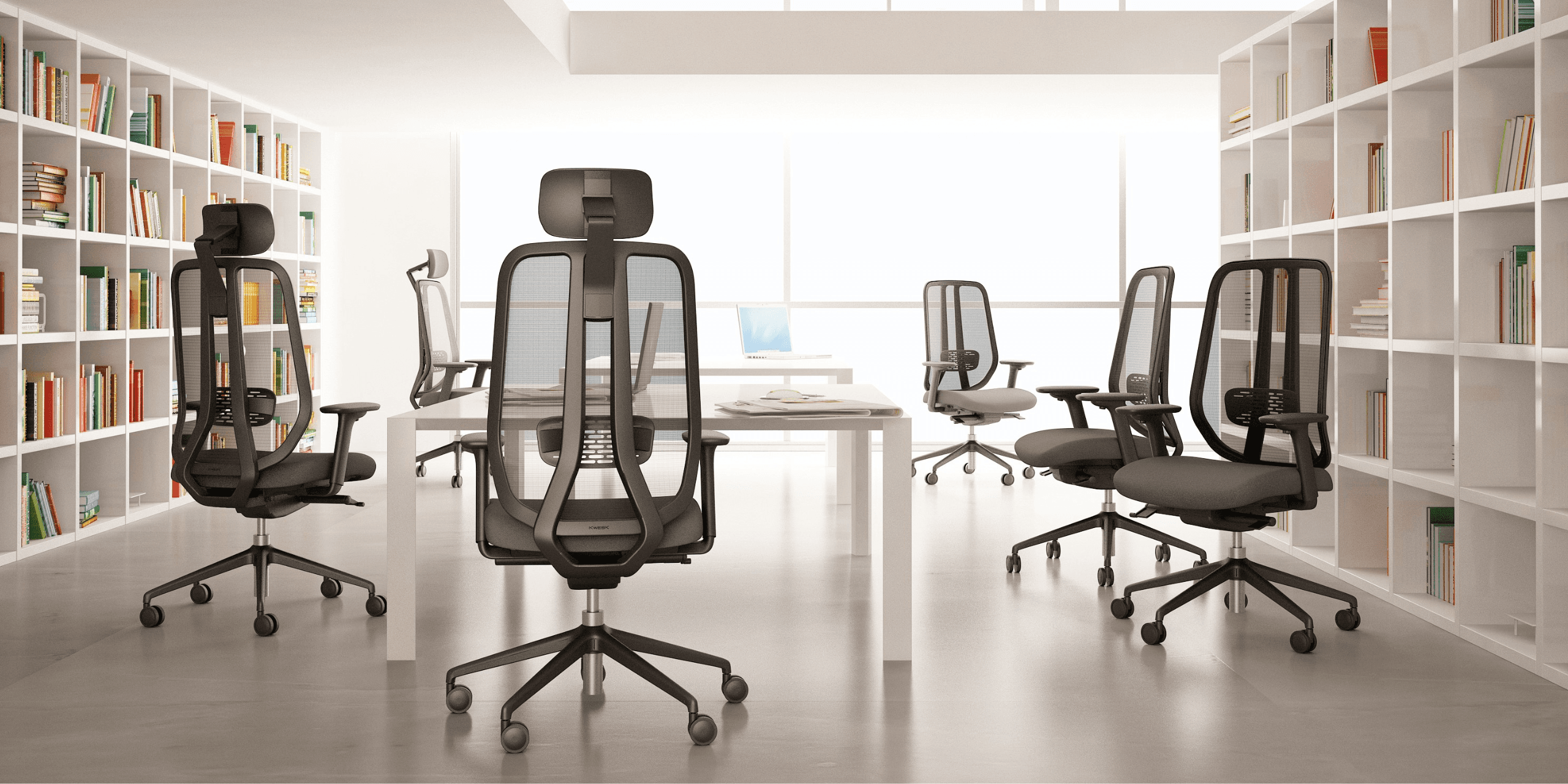
The industrial style pairs naturally with chairs that have clean lines and technical materials. KWESK ranges — designed for intensive use with a 5-year warranty — offer several configurations suited to this universe:
- The Challenger range: clean design and robust structure, perfect for industrial-style open-plan offices
- The Gamma range: premium ergonomic comfort for management and executive workstations
- The Caddy range: compact and practical for meeting rooms and collaborative zones
To combine industrial aesthetics with occupational health prevention, our article on ergonomic chairs and MSK disorder prevention will guide you through the essential criteria not to overlook.
Wood Metal Furniture and Environmental Responsibility
Certified wood and recycled metal: a coherent choice
The CSR dimension of furniture procurement is becoming increasingly important in tenders and professional purchasing decisions. More than 60% of European buyers say they prioritize sustainable materials when purchasing furniture (Market Research Future, 2024).
Wood metal furniture responds well to these requirements — provided you verify the certifications:
- For wood: prioritize FSC (Forest Stewardship Council) or PEFC labels, which guarantee responsible forest management with controlled harvesting and reforestation
- For metal: recycled steel has a considerably lower carbon footprint than primary steel. Steel is also one of the most recyclable materials in the world, with a recyclability rate close to 90%
- For the finished product: the EU Ecolabel and Cradle to Cradle (C2C) certification attest to the furniture's recyclability at end of life
The AGEC Law: an opportunity for forward-thinking companies
The Anti-Waste for a Circular Economy Act (AGEC), in force since January 2022, already requires public buyers to integrate 20% of furniture from reuse and 15% of recycled content in their annual purchases (2024 targets, raised to 25% in 2030 respectively).
While these quotas currently target public buyers, private companies that anticipate these requirements are turning a future constraint into a competitive advantage. Choosing now an industrial wood metal furniture piece designed to last, repairable, and made from certified materials means getting ahead of regulatory expectations and signalling genuine CSR maturity to clients and partners.
2025 Trends: Wood Metal Furniture Reinvents Itself
The pure industrial style — raw steel, dark wood, exposed brick — is progressively giving way to a softer, more sustainable version. In 2025, the trends taking hold in professional wood metal furniture are:
Biophilic industrial: the alliance between metal frames and light wood species (bleached oak, natural pine, ash) brings warmth and lightness to spaces. Green plants and living walls complete the picture by softening the austerity of metal.
Coloured metal: matte black steel remains the benchmark, but sage green, terracotta, and petroleum blue finishes are gaining ground, enabling brand identity to be integrated into the furniture itself.
Style mixing: the contemporary office in 2025 is no longer defined by a single style. Wood and metal furniture coexists harmoniously with Scandinavian furniture, polished concrete elements, or touches of coloured acoustic fabric.
Visible durability: companies are deliberately choosing furniture whose quality is evident — exposed welds, steel bolts, unveneered solid wood — to signal their commitment to durability and authenticity.
According to the Observatory of Work Environments (2024), 78% of French companies planned to refurbish their offices before the end of 2025 to adapt to new ways of working. Industrial wood metal furniture is among the top preferred orientations cited by fit-out managers.
To explore strategies for fitting out open-plan workspaces with this type of furniture, our guide on how to design an open-plan office provides a complete methodology and concrete recommendations.
Conclusion
Wood and metal furniture is not just an aesthetic trend: it is a structural response to the contemporary challenges of professional workspaces — durability, flexibility, well-being, brand identity, and environmental responsibility. As companies rethink their offices to attract talent and improve collective performance, this type of wood metal office furniture offers a rare balance between visual character and functional rigour.
Investing in furniture that lasts, inspires, and adapts is investing in your teams. And nothing better illustrates this commitment than the care given to every element of the workspace — from desk to chair.
Ready to design your industrial workspace?
- Explore KWESK professional office furniture to find solutions tailored to your sector and volume
- Discover our complete range of ergonomic chairs for intensive use — 5-year warranty, shipped to 12 countries
- Contact our team for personalized advice and a custom quote