A well-designed work environment makes all the difference between an engaged team and employees who struggle to stay focused. Creating a modern office design goes far beyond aesthetics: it is a strategic investment that directly impacts productivity, employer attractiveness, and talent retention. According to the Human Factors and Ergonomics Society, a well-designed work environment can improve productivity by 15%. In a context where global employee engagement has fallen to just 21% in 2024 (Gallup), rethinking your office space has become a strategic priority, not an optional expense.
In this guide, discover how to design an office that combines modern aesthetics, ergonomics, and performance — with practical solutions tailored for businesses.
The Foundations of Modern Office Design
Defining the visual identity of your space
A modern office design starts with a clear vision. The visual identity of your space reflects your company's values and sends a strong signal to clients, partners, and employees alike. Before launching any fit-out project, ask yourself these essential questions:
- What style do you want to project? Minimalist, industrial, biophilic, or contemporary mixed?
- Which colors match your brand guidelines? Neutral tones (white, grey, beige) create an elegant setting, while color accents reinforce brand identity.
- Which materials should you prioritize? Natural wood, brushed metal, glass: the choice of materials shapes the overall atmosphere.
Office aesthetics cannot be separated from functionality. A beautiful but poorly organized space creates stress; a functional but soulless space demotivates. The challenge is finding the perfect balance between the two.
Ergonomics at the heart of design
Ergonomics is the invisible pillar of a successful office design. Companies that invest in ergonomic furniture see an average return on investment of €3 to €15 for every euro spent (HumanScale, 2024), through reduced absenteeism and lasting productivity gains.
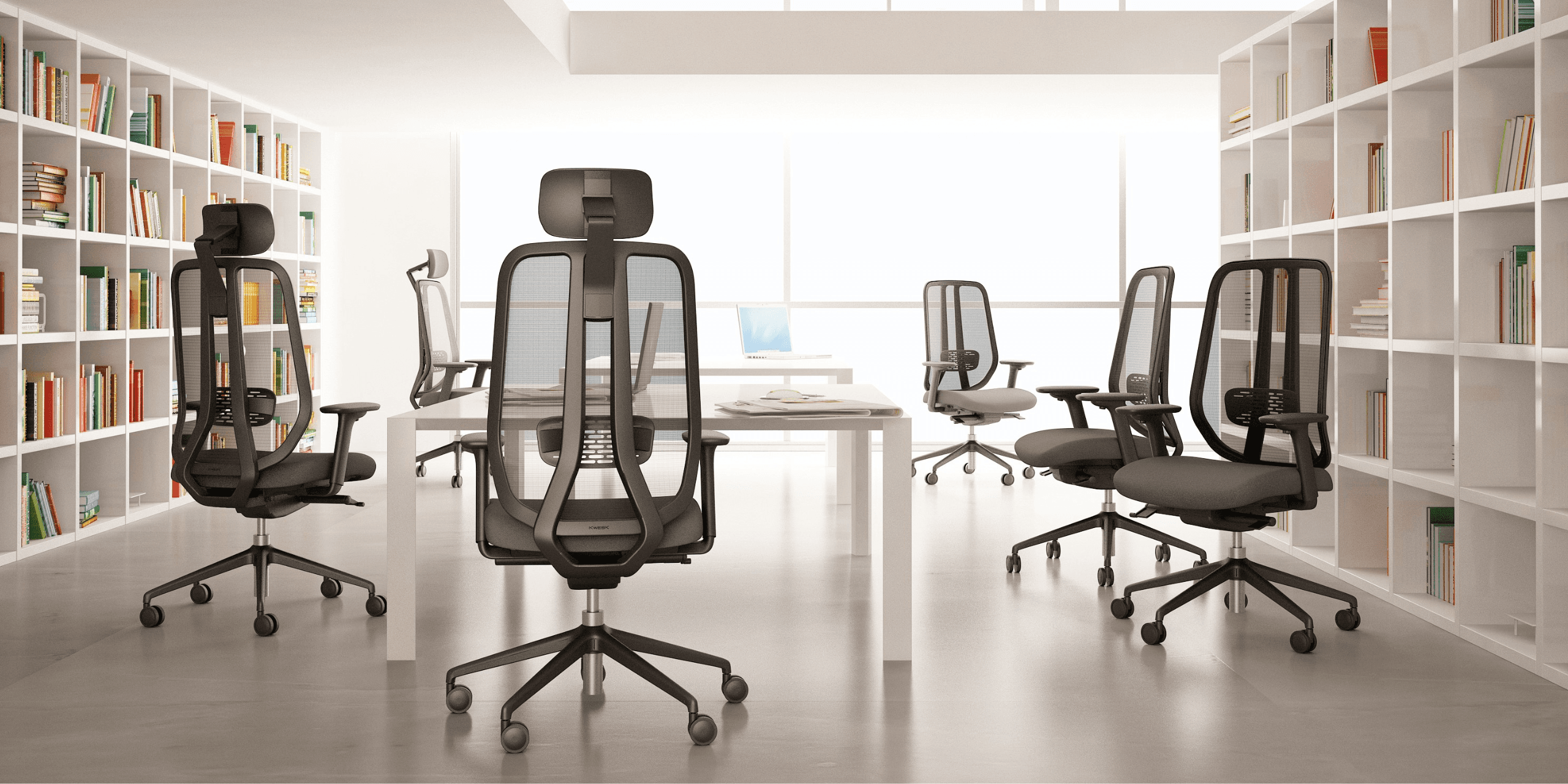
The designer office chair is the first element to optimize. A quality professional seat must offer:
- Adjustable lumbar support to prevent chronic back pain
- Seat height adjustability to suit each user's build
- Modular armrests to relieve shoulders and wrists
- Breathable materials suited to long working sessions
Discover KWESK professional office chairs, designed for intensive use with a 5-year warranty and a complete range for all workstation profiles.
2025 Trends: What Defines Office Design Today
Biophilic design takes over workplaces
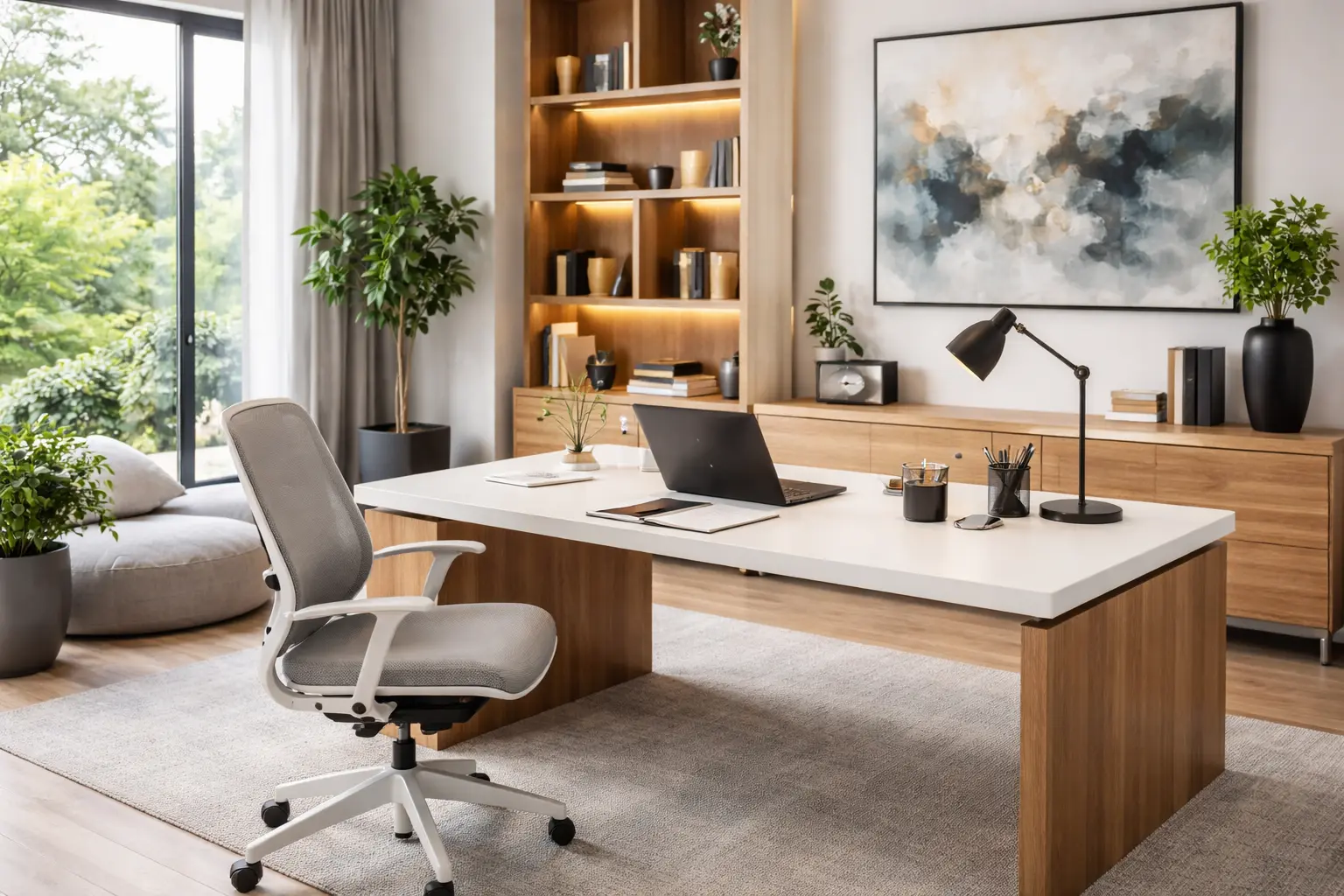
The most striking trend of 2025? Integrating nature into work environments. Biophilic design — incorporating plants, wood, natural light, and organic materials — is no longer reserved for trendy start-ups: it is now standard in headquarters and open-plan offices of all sizes.
The data speaks for itself:
- Employees exposed to natural light report 18% fewer absences compared to those working without windows (compiled study, 2024)
- Creativity increases by 15% in offices with strong biophilic elements (University of Minnesota, 2024)
- Each biophilic design investment can generate up to €2,000 in savings per employee per year through reduced absenteeism (Global Wellness Institute)
To integrate this trend without fully overhauling your premises: invest in strategically placed plants, green walls in reception areas, and opt for design furniture with natural wood finishes.
Flex office and modular design furniture
With 74% of employees at companies with more than 50 staff benefiting from remote work in France (INSEE, March 2025) and a hybrid rhythm stabilized at around 2 remote days per week, office spaces must adapt to fluctuating occupancy.
The answer: modular design furniture. Height-adjustable desks, mobile acoustic partitions, lightweight movable seating — all elements that allow a space to be quickly reconfigured according to daily needs. One third of French companies has already reduced its floor space in 2025 while improving the quality of retained spaces.
For in-depth strategies on flexible space planning, our guide to professional office layout provides practical insights based on the size of your premises.
Sit-stand desks: a worthwhile investment
The global sit-stand desk market reached $7.76 billion in 2023, growing at 5.2% per year (Grand View Research). This is not a passing trend: it is a direct response to the risks of prolonged sedentary work.
After one year of using a height-adjustable desk, 65% of users report improved productivity and increased concentration (Steelcase / ASID Foundation). Pairing this type of workstation with an ergonomic Gamma chair is now the most recommended configuration by office ergonomics specialists.
Our dedicated article on sit-stand desks covers all the criteria to consider when making the right choice.
Choosing the Right Design Furniture for Your Office
The designer office chair: the absolute priority
In a modern office design, the seat is the most strategic element. That is where your employees spend most of their day. A poor choice results in chronic pain, repeated medical appointments, and progressive disengagement.
What you must require from a professional designer office chair:
- Dynamic lumbar support — adaptive to movement, not rigid
- Multiple adjustments — height, backrest tilt, 3D or 4D armrests
- Durable materials — breathable mesh or technical fabric depending on use and desired image
- Certification for intensive use — designed for a minimum of 8 hours per day
The Challenger range delivers an excellent performance-to-aesthetics ratio for active open-plan offices. The Exclusive range is designed for executive spaces that refuse to choose between style and comfort. And for high-rotation operational workstations, the Corpo 100 range combines robustness with accessible pricing.
For executives and senior managers, our guide on executive seating: how to choose the perfect chair for leadership roles covers all the criteria to consider.
Desk and storage: functionality and aesthetics combined
A well-thought-out office design relies on impeccable organization. Visual clutter undermines concentration and the professional image you project. A few golden rules:
- Fewer visible cables: opt for desks with integrated cable management or discreet cable trays
- Smart storage: mobile pedestals, minimalist shelving, multifunctional partitions with integrated storage
- Appropriately sized work surfaces: allow a minimum of 160 cm width per workstation for roles using two screens
Our article on office storage furniture will guide you in choosing the most suitable storage solutions for your configuration.
Acoustics: the overlooked element of modern office design
Only 33% of employees report being satisfied with noise levels in their workspace (JLL HX Survey, 2024). Yet acoustics is one of the comfort factors most directly linked to the quality of deep work.
In a modern office design, acoustics can be managed at several levels:
- Decorative absorbing panels: wall screens, textile partitions that blend into the design
- Upholstered furniture: relaxation sofas, high-backed acoustic seating that creates natural privacy between workstations
- Soundproof booths or pods: for calls, video conferences, and intensive focused work
Practical tip: when selecting your chairs, high-backed models like the BY 100 range create an effective visual-acoustic barrier between workstations without requiring fixed partitions.
Planning Your Office Transformation Step by Step
Conducting an audit of the existing space
Before any investment in design furniture, objectively assess your current space:
- Which workstations are permanently occupied vs. used occasionally?
- What friction points have your teams flagged (noise, lack of light, physical discomfort)?
- What is the real occupancy rate since adopting hybrid working?
This audit will allow you to allocate your budget where the impact will be greatest, and avoid replacing what is already working well.
Prioritizing investments by ROI
Not all elements of a modern office design deliver the same return on investment. Here is a recommended priority order for procurement managers and office managers:
- Ergonomic chairs: direct ROI on productivity and health — companies that have adopted ergonomic practices report up to -32% in healthcare costs linked to musculoskeletal disorders (Occupational Medicine Journal)
- Optimized natural lighting: immediate impact on mood, alertness, and team energy
- Acoustic solutions: reduces interruptions and improves the quality of focused work
- Modular desks: essential flexibility to adapt to team changes and hybrid work patterns
- Biophilic decoration: impact on perceived well-being and company image with visitors
For a deeper analysis of your current workstation setup, our guide to workplace ergonomics provides a comprehensive evaluation framework.
Conclusion
A modern office design is not a luxury reserved for large corporations: it is a performance lever accessible to any organization that wants to take care of its teams and its image. In a context where employee engagement is under pressure and hybrid working is redefining how spaces are used, investing in an office that is both aesthetic, ergonomic, and modular is one of the most profitable decisions a company can make.
The data confirms it: productivity up, absenteeism reduced, turnover controlled, attractiveness reinforced among talent. And it all starts with the right design furniture choices — beginning with the chair your employees sit in every day.
Ready to transform your workspace?
- Explore the complete range of KWESK office chairs — designed for intensive use with a 5-year warranty
- Discover the key differences in our guide chair vs. office armchair: how to choose
- Contact our team for a personalized quote tailored to your premises and headcount