Your workspace directly influences your team's performance. According to a 2024 Gallup study, only 21% of employees worldwide report being truly engaged at work — a figure that costs the global economy over €438 billion in lost productivity. The good news? A well-designed office layout can reverse this trend. Companies that optimize their work environment see an average 17% increase in productivity (OpenSpaces, 2025).
Whether you are planning a complete office fit-out for new premises or reorganizing your existing spaces, this guide walks you through every step. From furniture ergonomics to acoustics, lighting, and air quality, discover the keys to an office space design that boosts productivity and retains your employees. As a leading Office Chair Manufacturer, KWESK has been supporting professionals in this transformation for years.
Why Office Layout Design Is a Strategic Lever
Office space planning is not just about arranging furniture in a room. It is a measurable strategic investment. According to a study published in ScienceDirect (2023), all indoor environmental quality components — furniture, lighting, acoustics, air quality — account for 84% of the variance in occupant productivity.
Direct Impact on Productivity
The numbers speak for themselves:
- Employees using ergonomic furniture report a 17% increase in productivity (Workplace Solutions, 2024)
- Offices with plants boost productivity by 15% on average (Arthur Loyd, 2025)
- An optimal temperature of 22°C maximizes performance — at 20°C, typing errors increase by 44% (Lawrence Berkeley National Laboratory)
Talent Retention and Wellbeing
In a competitive job market, 67% of employees consider workspace flexibility a key factor in their productivity (Arthur Loyd, 2025). An office layout designed for comfort reduces absenteeism by 37% and decreases posture-related complaints by 41% (Workplace Solutions, 2024).
A quality work environment becomes a powerful recruitment and retention tool. Companies that invest in ergonomic seating see a 58% drop in work-related injuries.
Office Space Planning Fundamentals
Meeting Space Standards
The French AFNOR NF X 35-102 standard — widely referenced across Europe — recommends a minimum of 10 m² per employee, whether in individual or shared offices. This standard also specifies:
- A minimum work surface of 120 × 80 cm
- Circulation clearance of 80 cm for single passage, 150 cm where two people may cross
- A maximum of 15 workstations per open-plan area
These recommendations ensure every employee has enough space to work effectively. Failing to meet them compromises both comfort and regulatory compliance.
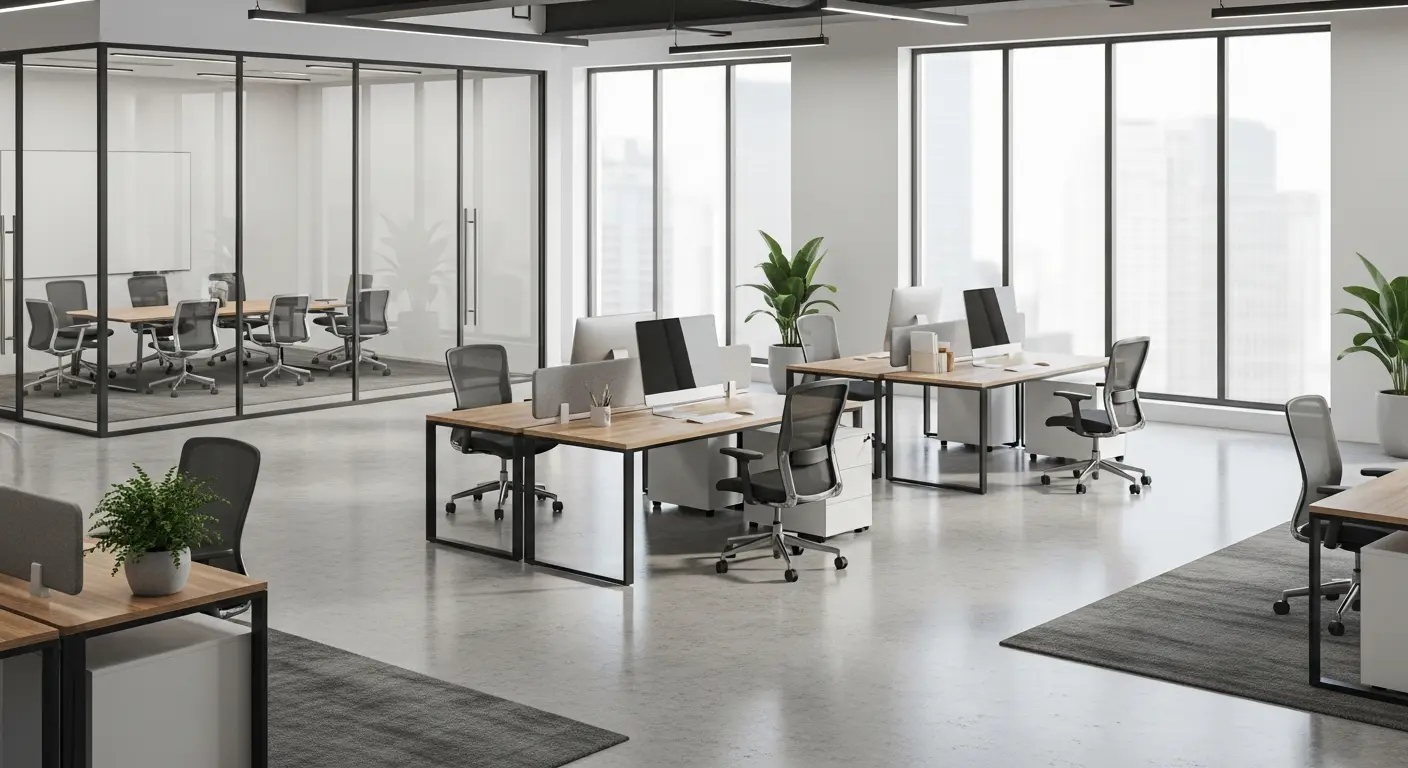
Choosing Between Open Plan, Private Offices, and Flex Office
Your workspace organization depends on your company culture and your teams' missions. Today, 78% of workstations worldwide are open-plan (CBRE, 2026), but this trend is shifting toward hybrid models.
Activity-Based Working (ABW) is emerging as the dominant trend in 2025-2026. This concept allows employees to choose their workspace based on the task at hand:
- Focus zones: enclosed or semi-partitioned spaces for deep work
- Collaboration zones: open areas equipped for teamwork
- Relaxation zones: informal spaces encouraging spontaneous exchanges
- Phone booths: acoustic pods for calls and video conferences
This approach reduces fixed floor space and can save up to 30% on real estate costs while increasing employee satisfaction by 25% (OpenSpaces, 2025).
Ergonomics at the Heart of Office Space Design
The global ergonomic office furniture market, valued at €6.28 billion in 2024, is projected to reach €11.6 billion by 2033 (Global Growth Insights). This growth reflects a widespread awareness: over 65% of employers have already redesigned their spaces with ergonomic equipment.
The Office Chair: The Cornerstone of Ergonomics
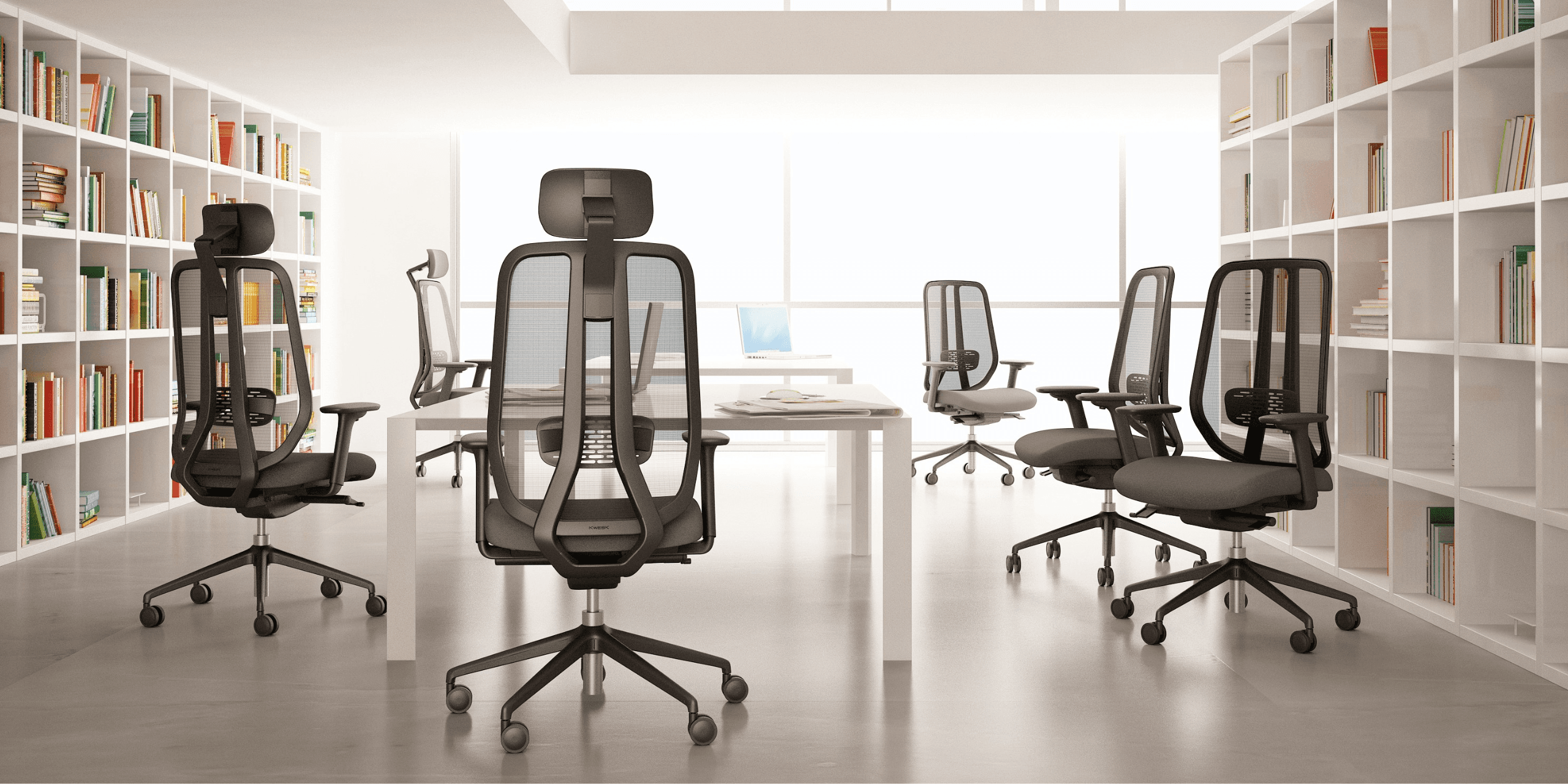
The average employee spends 8 hours a day sitting. Choosing a professional ergonomic chair is not a luxury — it is a necessity. A quality office chair should provide:
- Adjustable lumbar support to prevent back pain
- Height and width adjustable armrests
- A synchronous mechanism that follows the body's movements
- An adjustable seat depth suited to all body types
For executive positions, a premium executive chair combines extended comfort with a professional image. The Exclusive range from KWESK is engineered for this use, with a 5-year warranty. For workstations, the Challenger carries the same durability commitment.
Sit-Stand Desks and Smart Workstations
Height-adjustable desks are gaining ground. A Texas A&M University study found that employees using sit-stand desks are 45% more productive. After one year of use, 65% report increased productivity (Steelcase).
Smart workstations with AI-driven posture correction technology boost productivity by 23% and reduce employee fatigue by 40% (Industry Research).
Lighting, Acoustics, and Air Quality
Optimizing Lighting
Lighting is one of the most underestimated factors in office design. Standards recommend between 300 and 500 lux for a standard office and up to 1,000 lux for detailed tasks. According to Cornell University, workers in daylit office environments report an 84% reduction in eyestrain, headaches, and blurred vision symptoms.
Practical tip: prioritize workstations near windows and invest in circadian lighting systems that mimic natural daylight throughout the day.
Addressing Acoustics
Acoustics are the number one complaint in open-plan offices. According to Kollori (2024):
- 60% of open-plan workers complain about noise
- 25% say noise directly affects their productivity
- It takes an average of 20 minutes to regain focus after a noise interruption
Effective solutions for your office layout: wall-mounted acoustic panels, sound-absorbing partitions between workstations, acoustic phone booths, and noise-reducing floor coverings. These investments are among the highest-ROI improvements you can make.
Ensuring Air Quality
The Harvard COGfx study demonstrates that cognitive performance increases by 101% in clean-air environments ("Green+" conditions) compared to conventional offices. Every 500 ppm increase in CO2 slows response times by 1.4 to 1.8%.
Invest in high-performance ventilation, air purifiers, and air-cleaning plants to maintain healthy air in your spaces.
Biophilic Design: Bringing Nature Into the Office
Integrating natural elements into workspace organization is one of the strongest trends for 2025-2026. The Human Spaces report (Interface) shows that workers in greener environments are 6% more productive, 15% more creative, and report 15% higher wellbeing. In fact, 48% of employees wish they had access to a garden or green space at their workplace (Kollori, 2024).
In practice, incorporate:
- Living walls or planters in common areas
- Natural materials (wood, stone, cork) for surfaces and furniture
- Maximum natural light through glass partitions
- Outdoor views from workstations
Budget and Costs of Office Layout Design
Price Ranges in Europe
Budget is often the primary obstacle in an office fit-out project. Here are the ranges observed in 2024-2025:
| Type of Fit-Out | Estimated Cost (€/m²) |
|---|---|
| Basic refresh (paint, flooring) | €200 – €500 |
| Mid-range fit-out | €800 – €1,500 |
| Full fit-out (partitioning, technical systems) | €1,500 – €3,200 |
Sources: Camif Habitat, Cushman & Wakefield EMEA Fit-Out Cost Guide
In Morocco, office space prices in Casablanca range from 7,500 to 9,000 MAD/m² for purchase, with rents of 90 to 120 MAD/m²/month (Aujourd'hui le Maroc).
Getting the Best Value for Money
To manage your budget effectively:
- Prioritize ergonomic furniture — its ROI is proven through reduced absenteeism and increased productivity
- Choose modular furniture that adapts as your needs evolve
- Invest in durability — quality professional furniture lasts longer and costs less in the long run
- Consider pre-owned furniture for secondary spaces — check our guide on pre-owned office furniture to make the right choices
Checklist: 10 Steps to a Successful Office Layout Project
- Audit your needs — number of workstations, activity types, work modes (on-site, hybrid)
- Set your budget — plan a 10 to 15% contingency for unexpected costs
- Follow the standards — 10 m² per person minimum (NF X 35-102)
- Plan functional zones — focus, collaboration, relaxation, storage
- Choose certified ergonomic furniture — chairs, desks, accessories
- Optimize lighting — natural light first, circadian lighting as a complement
- Address acoustics — absorbing panels, partitions, appropriate coverings
- Bring in nature — plants, natural materials, outdoor views
- Plan for storage — cabinets, pedestals, and accessible filing solutions
- Test and adjust — gather employee feedback after installation
Conclusion
Office layout design is far more than an aesthetic choice: it is a strategic lever that directly impacts productivity, wellbeing, and employee retention. By following the best practices outlined in this guide — ergonomic furniture, functional space planning, natural lighting, acoustic treatment, and biophilic design — you create an environment where your teams perform at their best.
Every detail matters, starting with seating. Explore KWESK's ranges of professional ergonomic chairs, engineered for intensive use and backed by a 5-year warranty. For a tailored office design project, contact our experts and get a quote suited to your needs.